Penske Truck Rental is a significant name in the truck leasing industry, primarily due to its strategic partnerships and robust ownership structure. Understanding who owns Penske Truck Rental provides valuable insights for business owners looking to partner or engage with the company. This article will dissect the ownership structure, detailing the positions of Penske Corporation, Mitsui & Co., Ltd., and other stakeholders involved. Each chapter will delve into a specific aspect of ownership, offering a comprehensive overview that can guide decision-making and strategy for businesses considering Penske Truck Rental as a service.
Ownership by Design: Penske Truck Leasing’s Private Foundations
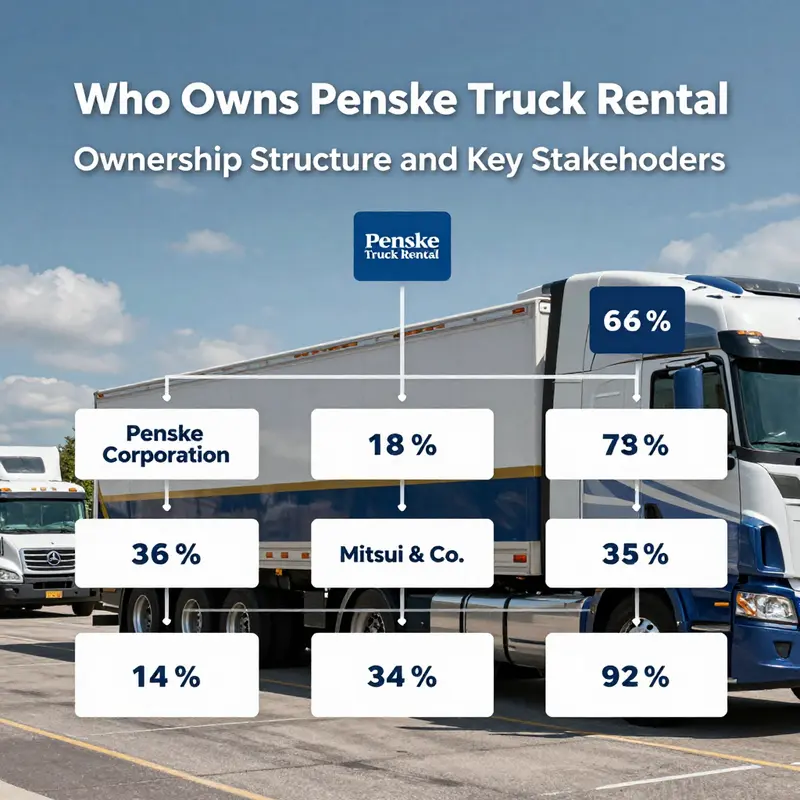
Ownership at Penske Truck Leasing is grounded in private, family-led control combined with strategic alliances. The company sits within Penske Transportation Solutions, a facet of Penske Corporation, which remains privately held and family-influenced. This structure shapes long-term planning, capital allocation, and service consistency in ways that public companies may not replicate on the same cadence.
A central feature is the three-way partnership among Penske Corporation, Penske Automotive Group, and Mitsui & Co., Ltd. Penske Corporation holds a controlling stake, reflecting a family-driven governance ethos. The partnership blends family stewardship with institutional capital and international reach, enabling fleet modernization, global procurement, and cross-border operations while preserving core values of reliability and customer focus.
Beyond ownership, governance and culture matter. The Penske family maintains an active role in strategic oversight, supported by professional management and a board that guides Penske Transportation Solutions, Penske Truck Leasing, and related entities. This setup seeks a balance between prudent risk management and the flexibility to invest in fleet renewal, safety programs, digital tools, and staff development.
For customers and partners, the result is a stable platform that can scale with demand across industries and geographies. The private family base provides continuity, while the Mitsui alliance brings international capital and market access. Together, they form a resilient ownership model designed to sustain performance, invest in people, and meet evolving transportation needs today and tomorrow.
Behind the Wheel of Ownership: The Penske Corporation’s Role in the Truck Fleet Network
Ownership questions in large fleet ecosystems rarely hinge on a single entity. In the case at hand, the question unfolds across a layered corporate family where a service arm, a leasing arm, and a multinational investor network all contribute to how customers experience the fleet and how capital is allocated to keep it moving. At the center of this structure sits a rental and fleet management operation that is part of a broader leasing company, which itself is a subsidiary of a diversified, privately held group led by a single founder whose name is widely associated with precision, performance, and long term planning. The practical takeaway for anyone trying to understand who owns the rental and leasing arm is that the operation is not standalone. It is part of a chain of ownership that starts with the parent company and extends through related investment vehicles and international partners. This creates a governance framework that aligns day to day service with long term strategy, risk management, and capital allocation, while maintaining a recognizable continuity of service for customers and channel partners alike. The result is a structure that is robust, interconnected, and designed to sustain a substantial fleet through cycles of growth and constraint in the transportation sector. In this system the rental service operates as a business unit under a leasing company, itself a subsidiary within a larger corporate umbrella. The top tier belongs to a closely held company that has built a diversified portfolio around on highway transportation services. That parent company is the ultimate source of strategic direction, approving major capital expenditures, fleet modernization programs, technology adoption, and the governance practices that preserve standards across subsidiaries. This arrangement matters for customers in ways that go beyond a single agreement or vehicle; it shapes the reliability, the scope of coverage, and the consistency of service that a national network can provide. It also explains how resources flow into this network when economic conditions, regulatory changes, or competitive pressures demand swift, coordinated responses. The financing and risk management capabilities embedded in the ownership structure enable the fleet to be refreshed on a recurring cycle, to adopt new telematics and safety programs, and to expand into new geographic markets with a shared operating rhythm. Turning to the specific ownership details helps illuminate how control is exercised without implying a single owner is making every micro decision. The relevant breakdown shows that the ultimate vehicle for control is a principal corporate entity holding the majority stake, while a substantial minority is held by a related investment vehicle and a major international partner. The numbers reveal a precise balance: Penske Corporation controls roughly 41.1 percent of the leasing co not by itself owning all voting power, but by being the largest single holder within a triad that includes a related investment vehicle with around 28.9 percent and Mitsui & Co., Ltd. with about 30.0 percent. This arrangement embeds a stable core of governance in Penske Corporation, while preserving a degree of external capital and influence from sophisticated international investors. The mix is deliberate. Penske Corporation brings its operational expertise, market insight, and close relationships with customers and suppliers. The related investment vehicle contributes a strategic layer of financial discipline and risk tolerance. Mitsui, a global conglomerate, provides access to international capital markets, a broad network of financing resources, and experience in large scale, asset-backed investments. Taken together, these stakes allow PTL to pursue fleet modernization, expand service capabilities, and maintain a robust balance sheet that can weather industry cycles. It is important to appreciate that the ownership figure is not merely about percentages on a chart. It reflects a governance architecture that assigns authority to the parent while recognizing the value of minority partners who provide complementary strengths. The presence of Mitsui as a 30 percent holder underscores the transnational dimension of fleet financing, a reality in which fleet managers must balance domestic operations with the opportunities and obligations of global capital markets. In practical terms this means decisions about equipment purchases, maintenance programs, safety initiatives, and digital platforms are guided by a shared framework among the primary owners. The Penske Corporation, as the leading stake holder, can set strategic priorities, approve major capital investments, and ensure that fleet policy aligns with the broader mission of the corporate family. The other two partners bring perspectives that help diversify risk and extend the organization’s reach, without diluting the core governance that ensures consistency of service, safety, and reliability across the network. As an element of this design, the historical record shows that as of the end of 2018 the controlling stake was substantial, with Penske Corporation directly or indirectly owning and controlling about 70.0 percent of the partnership. Of that total, roughly 41.08 percent was held through direct ownership. This snapshot highlights the sustained influence of the Penske family in steering the direction of the leasing and rental operations while acknowledging the strategic contributions from the other investors. The ownership structure also signals how the corporation can harmonize a suite of transportation service subsidiaries under a common governance philosophy. Penske Truck Rental, Penske Truck Leasing, and other related entities become part of a coordinated ecosystem rather than isolated entities each pursuing its own path. The result is a network that can deploy standardized fleet management practices, align procurement and maintenance cycles, and implement consistent safety and customer service standards across markets. The cross-holding arrangement matters for customers in several tangible ways. It supports a disciplined capital plan that keeps the fleet up to date and capable of meeting demand, from one way moves to longer term leasing arrangements. It also supports ongoing investments in training, technology, and maintenance protocols that contribute to predictable vehicle performance, reduced downtime, and improved overall reliability. The net effect is a fleet network that can respond to market shifts with agility while maintaining the stability customers expect from a well managed, long standing corporate family. For readers who want to connect these corporate facts to publicly accessible documentation, the ownership story is reflected in corporate disclosures and SEC filings that provide a precise, verifiable record of who owns what and when. Such documents trace the layers from the parent through the subsidiary and into the operational units, offering a transparent basis for understanding who holds the levers of control. In the broader ecosystem of transportation services this arrangement exemplifies how large, diversified groups structure ownership among a core operating company, a key strategic partner, and a major foreign capital provider to sustain growth and service continuity. If you are curious about the operational implications of this mix or want to explore how the ownership framework interacts with customer offers and fleet programs, you can find practical discussions in the internal literature that accompanies this topic here: penske-truck-rental-discounts. The chapter on governance and ownership is complemented by primary documentation in the public record, which remains the definitive source for exact stake percentages and the evolving structure over time. For readers seeking the authoritative baseline, the SEC filings provide the clearest, most durable reference point that guides investors, regulators, and corporate partners through the intricate layers of ownership. In the end, the story of who owns the rental and leasing arm is really a story about how a corporate family coordinates capital, governance, and strategic direction across a network that is both domestic and international. It is a story that emphasizes continuity, disciplined investment, and the shared objective of delivering reliable transportation solutions to customers while maintaining a resilient platform for future growth. For those who want to verify the precise figures and the latest state of the ownership arrangement, the official public records remain the best source of truth, and they paint a clear line from Penske Corporation to the fleet on the road today. External documentation can be reviewed through the primary source linked here: https://www.sec.gov/Archives/edgar/data/1175644/000117564425000028/penske-20251119.htm
Who Owns Penske Truck Rental: Tracing the Corporate Chain Behind a Major Fleet Service
The question of ownership around a large, asset-heavy fleet service is never just a matter of who writes the checks. It is a question of how those checks align with a broader strategy, how governance is structured across a diverse set of business lines, and how minority partners can influence long-term direction without interrupting day-to-day reliability. In the case of Penske Truck Rental, the answer is embedded in a layered corporate architecture that centers on Penske Corporation, with a notable but more distant role played by Mitsui & Co., Ltd. through a related investment vehicle. The result is a stable, governance-driven model in which the rental and leasing operations sit firmly under the umbrella of a family-controlled corporate group, while minority investment adds strategic breadth rather than ownership control over the core rental business itself. Understanding this structure helps explain why Penske Truck Rental can offer a consistent customer experience across markets while still pursuing ambitious fleet modernization and geographic expansion strategies.The starting point is Penske Truck Leasing Co., L.P., the legal entity that underpins the rental and leasing operations. As of December 31, 2018, the ownership ledger pointed to Penske Corporation as the controlling force, with a 70.0 percent stake in the partnership—controlled either directly or through related entities. That figure translates into a direct, substantial ownership share in the 41.08 percent range in certain organizational configurations, underscoring Penske’s central role in governance and strategic decision-making. In practical terms, the parent company wields the decisive voice in major policy choices—from fleet composition and maintenance standards to pricing philosophy and expansion plans. The structure is designed to preserve a unified strategic direction even as the business scales to serve a nationwide, and increasingly cross-border, customer base. This is not mere ownership for ownership’s sake; it is a deliberate architecture intended to balance consistency with agility in a sector defined by capital intensity and operating leverage.Where Mitsui & Co., Ltd. fits into the picture is a point of frequent curiosity. Mitsui is a significant investor within Penske’s broader ecosystem, but not a direct owner of Penske Truck Rental itself. Instead, Mitsui’s influence centers on its stake in Penske Transportation Solutions (PTS), a platform that coordinates elements of the transport and logistics portfolio across the Penske group. In the latest publicly available information, Mitsui holds roughly 28.9 percent of Penske Transportation Solutions. This arrangement means Mitsui contributes to strategic considerations at the level of transport services and related business opportunities, while the Penske organization retains direct ownership and operational control over Penske Truck Leasing and the associated rental unit. The distinction matters for those tracing accountability: Mitsui’s influence is strategic and portfolio-wide, not a direct veto on rental operations, which remain firmly anchored in the Penske corporate framework. If you want to see the formal documentation behind these relationships, the SEC filings provide the clearest view of the ownership structure and the roles of the various entities involved in Penske’s complex network of partnerships.From a governance standpoint, majority ownership translates into clear lines of authority. Penske Corporation’s controlling stake means that the executive leadership and board oversight can prioritize capital allocation, risk management, and long-range investments with a coherent, enterprise-wide logic. This is crucial for an organization whose business model relies on heavy asset deployment, long-term fleet renewal cycles, and nationwide service delivery. The structure supports coordinated procurement, standardized safety and maintenance programs, and a unified approach to driver training—areas where scale matters as much as speed. It also enables the corporate center to align disparate regional operations with a single set of standards, ensuring that a customer moving from one city to another experiences the same level of service quality, vehicle availability, and support infrastructure. At the same time, the presence of a minority investor in Penske Transportation Solutions introduces a channel for capital diversification and strategic dialogue without disrupting the established management cadence of the rental and leasing arm. This balance—stable control with diversified opportunity—helps Penske navigate economic cycles and regulatory changes without sacrificing reliability or throughput.For customers and industry observers, the practical implications of this ownership arrangement are significant. A central, parent-led governance model tends to translate into consistent policies on fleet sourcing, maintenance cycles, and safety protocols. It supports nationwide pricing discipline and the ability to invest in fleet modernization at a scale that smaller operators cannot match. The integration of data and telematics across a large, standardized fleet also benefits from centralized oversight, enabling better utilization, route planning, and risk management. Moreover, the Mitsui connection, while not altering who owns the rental unit, reflects a broader strategy of leveraging cross-border capital and insights. It signals to lenders and investors that the Penske platform seeks to balance ownership clarity with strategic flexibility—an approach that can bolster resilience in volatile markets while sustaining commitments to service levels that customers rely on when planning moves or fleet placements.As with any complex corporate ecosystem, there are nuanced tensions to acknowledge. Minority investment through Penske Transportation Solutions means Mitsui participates in strategic discussions that touch on the broader portfolio’s direction, potentially influencing how the group allocates capital to related ventures or expands into adjacent services. Yet because Penske Truck Leasing and Penske Truck Rental sit within the Penske Corporation’s ownership ladder, those decisions remain anchored in a stable, parent-driven framework. The separation between direct operational control and minority investment in a related but distinct entity helps prevent strategic drift and protects customers from potential disruptions that a more fragmented ownership pattern might invite. This layered structure also explains why public disclosures and SEC filings are consulted to understand the precise stakes and the roles of each party. The careful documentation underscores a governance philosophy that prioritizes continuity, disciplined investment, and a clear hierarchy of authority—principles that, in practice, translate into dependable service across markets, a reliable equipment lineup, and consistent safety benchmarks that operators and drivers can count on.For readers who want to explore how such ownership dynamics translate into cost considerations and customer incentives, a practical note emerges. The pricing and discount strategies often advertised in the brand’s broader communications are grounded in the same enterprise-wide logic: a unified procurement framework, centralized fleet management, and a commitment to giving customers predictable, transparent options. To see a concrete example of discount-oriented content tied to Penske’s rental offerings, you can review this resource with anchor text derived from the relevant URL: Penske Truck Rental Discounts. This link offers a window into how pricing policies are presented to customers while remaining consistent with the overarching governance model that originates from Penske Corporation’s ownership and control structure.In sum, Penske Truck Rental operates within a tightly controlled corporate ecosystem. Penske Corporation holds the controlling stake in Penske Truck Leasing Co., L.P., positioning the parent company as the primary driver of strategic decisions and capital allocation. Mitsui & Co., Ltd., participates as a strategic minority investor through Penske Transportation Solutions, adding international capital and portfolio-wide perspectives without overturning the core ownership dynamic of the rental business. The SEC filings are the most authoritative source for these relationships, while the day-to-day customer experience reflects the benefits of scale, standardization, and disciplined governance that such ownership arrangements are designed to deliver. For readers seeking historical context and verification, the official documents and filings offer the detail that literature often summarizes in broad strokes, capturing the steady, long-term balance that has allowed Penske Truck Rental to grow while maintaining a reliable, cohesive service standard across its footprint. External source: https://www.sec.gov/Archives/edgar/data/1568626/000119310119003895/0001193101-19-003895-index.htm
Ownership at the Helm: Tracing the Corporate Backbone Behind Penske Truck Rental
Ownership is more than a percentage; it is the governance that steers strategy, investment, and risk in a mobility-driven business. In Penske’s ecosystem, governance flows from Penske Corporation to its operating subsidiaries, shaping control, financial health, and strategic direction across fleets, service lines, and markets. To understand who owns Penske Truck Rental, you must follow the layered structure that underpins the Penske ecosystem, where a parent company and affiliated entities interact to define outcomes. The core relationship is straightforward in arithmetic, yet rich in governance implications.
Penske Truck Leasing Co., LP operates as the vehicle-leasing and fleet-management arm within the Penske framework. As of December 31, 2018, Penske Corporation directly or indirectly controlled 70.0% of Penske Truck Leasing Co., LP, while Penske Truck Leasing itself held a 41.08% stake. This layered arrangement means the parent has the authority to set policies, approve investments, and steer risk management, aligning fleet strategy and capital deployment with the broader Penske agenda. The governance architecture thus channels the Penske brand’s strategic priorities through its dominant ownership position, rather than through a standalone operator.**
Within the Penske family, Penske Transportation Solutions (PTS) forms another key piece. Ownership ties within the Penske ecosystem remain oriented toward the Penske Corporation’s majority stake, with cross-holdings such as Penske Automotive Group (PAG) owning 28.9% of PTS. This arrangement demonstrates how strategic influence can traverse divisions without altering the governance of Penske Truck Leasing or Penske Truck Rental. In practical terms, PAG’s stake in PTS supports aligned strategic goals, rather than shifting governance of the Penske Truck Rental operation itself. The governance model remains anchored in Penske Corporation’s majority position, preserving a coherent direction for fleet policy, safety standards, and market expansion.**
From a governance perspective, the 70.0% control of Penske Truck Leasing Co., LP signals a centralized decision-making framework. The general partner typically has the strongest control rights, enabling Penske Corporation to set overarching policies, manage risk, and steer capital deployment across the fleet. This fosters consistency in fleet renewal, maintenance standards, and service commitments—factors that underpin reliability and customer satisfaction. For customers, a centralized governance model often yields predictable service levels, standardized safety and compliance, and a unified approach to pricing tied to fleet health and utilization.**
It is important to acknowledge that ownership numbers are a snapshot in time. The Penske ecosystem is dynamic, and later filings may reflect changes in stakes or control arrangements. For the most current understanding, consult official filings and disclosures from Penske Corporation and related entities. Public regulatory documents and SEC filings related to Penske Truck Leasing Co., LP provide granular detail on ownership distribution, profit allocation, and the terms of the partnership structure. These sources serve as a formal ledger of how control evolves as the business responds to market opportunities, regulatory shifts, and portfolio adjustments in the transportation sector.**
From a customer-facing perspective, the ownership structure influences reliability, consistency, and scalability across geographies. A parent with majority influence tends to standardize procurement, fleet modernization schedules, and safety protocols, supporting smoother cross-border operations and uniform service quality. A centralized model also affects resilience: access to capital and willingness to fund fleet refresh initiatives can determine whether new service offerings emerge or regional coverage expands. While the governance narrative emphasizes control, its practical impact is seen in the speed and predictability with which Penske can respond to demand, maintain equipment, and deliver consistent customer experiences.**
For readers seeking deeper, formally verified detail, the most precise information comes from the latest regulatory filings and corporate disclosures. The cited ownership percentages reflect a historical snapshot and should be interpreted within the context of subsequent corporate developments. Official SEC filings linked in prior disclosures provide the rigorous framework for ownership, profits and losses allocation, and continuity of control within Penske Truck Leasing Co., LP. External references: SEC filings and related corporate disclosures elucidate how governance is structured and maintained across the Penske fleet and its services.**
Under the Corporate Roof: Ownership, Structure, and the Road Ahead for a Leading Truck-Rental Arm
Ownership questions that sit at the heart of a large freight and mobility ecosystem often reveal more about the corporate DNA than about any single brand. In the case of the truck-rental arm that riders and fleets rely on, ownership is not a lone proprietor’s stamp but a carefully composed structure nested inside a diversified transportation group. The story begins with the founder, Roger Penske, who established a modest car and light-truck rental operation in eastern Pennsylvania in 1969. That seed grew into a broad enterprise whose reach now spans fleet leasing, transportation solutions, automotive retail, and related services. The rental arm is not a standalone company; it sits as a business unit within Penske Truck Leasing, and that leasing entity, in turn, is managed under the umbrella of the parent corporation. This layered arrangement is not merely a matter of corporate charting; it shapes strategic choices, investment horizons, and the way the fleet evolves to meet both consumer and commercial demand. The ownership story, though anchored in history, points toward a future in which stability and long-term planning are the governing principles behind every decision about equipment, technology, and service offerings.
To understand the ownership fabric, it helps to map the immediate and the broader connections. Penske Truck Leasing operates the rental arm as part of a larger operating family, with Penske Corporation holding the reins of day-to-day governance through its control of the leasing entity. In other words, the operational heartbeat of the rental business flows through Penske Truck Leasing, and that leasing unit is wholly controlled by Penske Corporation. The structure is intentionally centralized: a single corporate parent coordinates the core business lines, while the broader Penske family adds layers of capability through affiliated entities.
The immediate family of Penske businesses adds another dimension to ownership. Penske Automotive Group sits alongside the leasing and transportation solutions units, and this company owns a stake in the broader Penske Transportation Solutions framework. Specifically, Penske Automotive Group holds a notable, though not majority, stake in Penske Transportation Solutions, illustrating the interconnected nature of the Penske corporate family. The transportation solutions umbrella aggregates various service lines that can feed into the rental enterprise—fleet management, logistics coordination, and related services that smooth operations for customers who require flexibility and reliability in moving and goods transport. The result is a carefully balanced ecosystem in which the rental arm benefits from shared platforms, cross-sell opportunities, and a common technology backbone designed to improve efficiency and customer experience.
Historical ownership figures offer a snapshot of the scale and scope of the arrangement. As of December 31, 2018, Penske Corporation directly or indirectly owned and controlled about 70.0% of the Penske Truck Leasing partnership, with roughly 41.08% of direct holdings belonging to Penske Corporation. This reflects a strong majority influence by the parent company, even as the partnership includes other strategic investors such as Penske Automotive Group and Mitsui & Co., Ltd. The distribution among these partners underscores the collaborative, multi-party structure that supports expansion while preserving the core governance and strategic direction under the Penske umbrella. The precise composition can change over time as corporate reorganizations occur or as strategic alliances evolve, which is why the most current ownership details are published on the official corporate site. Those who study corporate governance or who plan long-range investments in the sector often view this history as a case study in how a tightly aligned family of companies can pursue growth while maintaining a unified standards-based approach to service and safety across a diverse fleet.
This indirect ownership model yields tangible implications for stability and strategic focus. When a parent company steers the wheel, a rental arm benefits from a longer horizon and a disciplined capital plan. Fleet modernization becomes a shared ambition rather than a one-off project funded in response to a single quarter’s results. The dividends of this setup show up in practical terms: a fleet that is continually refreshed with newer, cleaner vehicles; access to comprehensive maintenance and training resources; and a cross-pollination of best practices across a broad set of mobility and logistics solutions. In a market where customers increasingly demand reliability, speed, and transparent pricing, the ability to align fleet standards with corporate governance and long-term environmental and regulatory goals becomes a competitive advantage already baked into the ownership model.
Another axis of value comes from the synergy between the rental operation and the broader Penske platform. The interconnected network of services—fleet leasing, transportation solutions, and automotive operations—creates a fertile ground for operational efficiencies. Telematics, route optimization, and centralized procurement can be scaled across the fleet with a common platform, reducing costs and improving service consistency. As markets evolve toward digital experiences, this vertically integrated structure allows the rental arm to adapt more readily to digitalization. Customers benefit from smoother booking, better vehicle availability, and more responsive roadside and maintenance support because the underlying systems are designed to talk to one another across divisions. In practical terms, this means customers can access a more seamless moving or logistics experience, with fewer handoffs, clearer accountability, and a more predictable service standard.
The future directions and implications of ownership, then, are not speculative abstractions but concrete strategic vectors. Stability in ownership translates into a sustained focus on core competencies—fleet maintenance, safety, and reliability—while preserving the freedom to pursue strategic investments that enhance capability over time. Fleet modernization becomes not a one-off capital expenditure but a continuous program, supported by the parent company’s capital discipline and long-term planning. This places the rental arm in a position to expand services in ways that complement the parent organization’s strengths, whether that means deeper integration with logistics and warehousing, enhanced customer support ecosystems, or more sophisticated fleet analytics that guide both pricing and maintenance planning.
Industry trends amplify the rationale for this structure. The rise of digital tools—telematics, data analytics, and customer-facing digital interfaces—benefits from a unified technology strategy across the Penske network. A vertically integrated group can deploy common software platforms, data standards, and security protocols more efficiently than a loosely affiliated set of independent operators. Likewise, sustainability has moved from a regulatory obligation to a market expectation. Electrification and alternative-fuel strategies, though nuanced by geography and duty cycle, are more readily implemented when the parent company maintains a coherent fleet strategy and has the scale to negotiate favorable terms with equipment suppliers and energy providers. The capacity to pilot electrified demonstrations and gradually scale them across the fleet offers a practical pathway from concept to deployment, with governance, risk management, and return-on-investment discipline already in place at the corporate level.
The ownership framework also shapes the customer experience in subtler ways. A stable, well-capitalized parent with a broad service portfolio can offer customers more predictable terms, broader service coverage, and the confidence that the fleet and the people behind it are supported by a durable organizational backbone. For those tracking the evolution of the rental landscape, the narrative of ownership is as important as the fleet’s size or the color of the trucks. It signals the ability to invest consistently, to coordinate across business lines for enhanced efficiency, and to pursue strategic initiatives that keep the service relevant as moving and logistics needs become more complex and more interconnected with technology.
For readers who want a concrete, practical signal about how this ownership structure translates into everyday value, a straightforward entry point is to explore the broader service ecosystem in one of the brand’s practical guides, which discusses options and considerations for one-way moves and related services. This resource offers a grounded look at how customers experience the fleet and services in real-world terms, bridging the gap between corporate structure and everyday usage. One-way moving truck rental guide.
What remains clear is that the ownership arrangement—anchored by Penske Corporation and reinforced through its allied entities—provides a continuum of support for the rental arm. It sustains a long-range strategic orientation, aligns investments with broader capabilities, and positions the operation to meet the evolving needs of both consumer customers and commercial fleets. As the corporate family continues to evolve, the authoritative snapshot of who owns what sits at the official Penske site, where ownership percentages and governance details are regularly updated to reflect changes across the enterprise. This is not just a matter of corporate trivia; it is the backbone of the rental arm’s capacity to modernize, expand, and adapt in a rapidly changing transportation landscape. For those who want to delve deeper into the formal ownership narrative, the primary source remains the Penske Corporation’s official site.
External resource: Penske Corporation official site — https://www.penske.com/our-companies
Final thoughts
Understanding the ownership structure of Penske Truck Rental, particularly the intertwined roles of Penske Corporation and Mitsui & Co., Ltd., offers business owners a clearer view of the strategic direction and reliability of the service. With such significant stakeholders involved, the company is positioned to leverage its resources for growth, making it an appealing option for businesses seeking truck rental solutions. Companies considering partnerships or utilizing their services can now make more informed decisions by grasping the intricate dynamics of ownership.