

For business owners looking to move their operations or transport goods, finding an economical truck rental option is vital. The costs associated with moving can quickly escalate, impacting your bottom line and operational efficiency. This article aims to provide a comprehensive understanding of the cheapest truck rental options available for moving, focusing on three key areas: an overview of the most affordable truck rental choices, a detailed cost analysis comparing truck rentals to local moving services, and identification of the key factors influencing rental costs. By the end, you’ll be equipped with the knowledge to make informed decisions that align with your budget while ensuring a smooth moving process.
Frugal Haul: A Deep Dive into the Cheapest Truck Rentals for Local Moves

External resource note: for a deeper look at the pricing and options available through a leading national network for in-town truck rentals, you can consult the following external resource. It provides a detailed snapshot of base daily rates, mileage policies, and promotional opportunities that can influence overall move costs: https://www.uhaul.com/moving-trucks/in-town-truck-rentals/
Budget-Smart Relocations: A Thorough Look at the Cheapest Truck Rental vs. Hiring Local Movers
Moving costs are rarely as simple as a single price tag. People often assume the cheapest truck rental is the clear winner, but true affordability hinges on a broader equation. The real question isn’t just which option has the lowest daily rate; it’s which choice minimizes total cost over the course of a move, while balancing time, effort, risk, and peace of mind. In practice, the cheapest path depends on factors you can control and factors you can’t. You can control the size of the vehicle you rent, the distance you drive, how long you keep the truck, and whether you hire labor to help with loading and unloading. You can’t control the size of your move, the fragility of your belongings, or the realities of traffic and weather. The interplay of these elements determines the true price of moving and helps distinguish a bargain from a false economy.
When you begin with truck rental, initial costs often look appealing. A compact cargo van or a small box truck can carry the items of a one- to two-bedroom apartment, and the daily rate often appears to be one of the lowest moving costs you’ll encounter. In a few markets, small cargo vans may be advertised at roughly thirty to forty-five dollars per day, especially for short durations. The instinct to grab the cheapest daily rate is understandable, but it’s just the opening line of a longer financial story. Behind that low headline price lie several other charges that can swell the final bill. Fuel is the most obvious variable. A larger truck guzzles gasoline faster than a car, and even modest miles add up quickly if you’re moving across town or to a different neighborhood. Mileage policies vary, and some rentals impose higher charges for long-distance trips or for driving in congested urban corridors where fuel consumption spikes with stop-and-go traffic. In many rental agreements, your lowest upfront price can balloon once you’ve logged several hours or miles beyond a threshold, turning a seemingly cheap option into a costly choice.
Insurance is another crucial factor. Most rental agencies require some form of coverage, and your personal auto policy may or may not extend to a rental truck. If your personal policy won’t cover the truck, you’ll need to purchase an extra insurance package from the rental company. The premium can be modest at first glance but adds to the daily cost and can accumulate over days or weeks of use. The risk of damage, even with careful packing, is a factor that weighs into the decision. A dented bumper, a scratched door, or an issue with the loading ramp can trigger penalties or fees, especially if the vehicle is returned with more wear than the agreement anticipates. These potential add-ons—insurance, incident fees, cleaning charges, and late return penalties—are the staircase to a higher total cost that often defeats the original bargain.
Then there are the logistics costs that aren’t obvious from the price tag. Toll charges, especially for routes that slice through city centers or cross regional borders, can quietly add a few dollars here and there, but those can escalate over the course of a move. Parking, loading zone time, and the necessity to reserve curb space in busy neighborhoods can translate into fees or time delays. Time itself becomes a cost driver. If your move requires more than a single day because you’re shuttling items in multiple trips or because you’re loading and unloading at a slower pace, the daily rate multiplies as well. The longer you keep the truck, the more you pay, and that multiplier can erase the savings you expected from the low daily rate.
Beyond the vehicle, there is the practical labor question. A move that looks straightforward on paper often evolves into a physically demanding task. Loading a heavy couch, disassembling a bed frame, or wrapping fragile items securely demands time and energy. If you’re alone or with one helper, the total time required to complete the move will be longer, potentially inflating both the rental duration and the amount you pay for fuel and tolls. You also need to consider your own tolerance for risk. When you handle the packing and loading yourself, there’s a non-monetary cost: the potential for personal injury or back strain if you’re not careful. In short, the cheapest truck rental can end up costing more when you consider the value of protection against fatigue and mishaps.
On the other hand, hiring a local moving service reframes the expense structure entirely. These teams package labor, time, and expertise into a single, itemized quote. They bring muscle, skill, and a process. The labor cost covers the physical work of loading and unloading, which is the most time-intensive portion of many moves. Packing materials—boxes, tape, padding, and special materials for fragile items—are included or offered as part of the service. Professional movers typically provide insurance coverage for the items they transport, which shifts part of the financial risk away from you. In practice, what seems more expensive at the outset often translates into a broader, more predictable cost with more predictable outcomes. You are paying for time saved and for the expertise that minimizes the chance of damage to valuables.
The cost calculus for hiring local movers is anchored in a few core inputs. Quote foundations usually include the volume of goods, the distance to the new location, and any additional services you request, such as furniture disassembly and reassembly, or the handling of particularly heavy or awkward items. Volume is the most tangible factor: more boxes and larger pieces require more labor and more equipment, so the price tracks higher. Distance matters as well; longer trips demand more time and more fuel in the sense of the labor cost. Additional services can swing the total in either direction, depending on the complexity of the move. A small, tight, one-room relocation may require minimal labor and materials, yielding a relatively modest quote. A full-house move with delicate or high-value possessions may command a higher premium, but the value delivered by reduced risk and faster execution becomes clearer when you add up the savings in time and sanity.
A practical look at numbers helps illuminate the decision. The research landscape as of February 2026 suggests a general pattern. For a compact, urban move, a small cargo van or a similar vehicle can be rented for roughly thirty to forty-five dollars per day. Short-term rental services that offer flexible one-day or two-day windows typically fall in a similar range, around thirty to sixty dollars per day, depending on vehicle type and distance driven. These figures reflect the appealing headline rates, but the full cost is determined by mileage, fuel, and the possibility of extra insurance or fees tied to the rental agreement. By contrast, hiring local movers for a short-distance move—say fifty kilometers or less—can bring the total to around one hundred to one hundred fifty dollars, all-in, including labor and basic transportation. The range can vary with locale and the exact scope of the move, but the overarching point is clear: when labor and materials are included, the total cost of a moving service can be competitive with, or even lower than, a bare rental if your move is simple but you value speed and reduced physical exertion.
This dynamic is especially notable for moves that are not strictly one-truck, one-trip events. If you anticipate needing multiple trips to ferry everything, or if you have a lot of bulky furniture or fragile items, the cost of renting a truck can begin to climb quickly. In those scenarios, the labor-forward model can become more attractive, because movers not only transport but also secure, wrap, and protect your belongings. They manage the risk of damage and the logistics of stacking and loading efficiently, which translates into less time spent in transit and on the clock. The broader takeaway is that the cheapest option is not always the option with the lowest listed price. It is the option that minimizes the total time, risk, and effort you personally bear while ensuring your possessions arrive intact.
To make this concrete, consider a few situational scripts. If you’re moving a handful of items and you live within a short radius—say under 50 kilometers—the most economical choice might be to hire a local driver with a compact van through a platform that pairs transportation with short-term labor. This approach often yields a lower total cost than renting a larger truck, fueling it, and spending the day loading and unloading yourself. If, however, you’re relocating a larger amount of furniture or you’re moving across a longer distance, a rental truck paired with a couple of helpers you hire independently could still be competitive, provided you account for fuel, tolls, insurance, and time. But if you’re juggling a long-distance move with fragile items, the value of insured, professional handling rises sharply, and the cost difference between a rental plus DIY labor and a full-service moving crew often tilts toward the latter.
For readers who want to explore a deeper, itemized framework, it helps to think in terms of four major cost blocks. The first is the fixed, or upfront cost, which for a rental is the daily or weekly rate. The second is the variable cost tied to distance, including mileage charges and fuel. The third is insurance and potential damage-related costs, which may be included or offered as add-ons. The fourth is the labor and service costs, which dominate the total when you hire professionals. Each block can be influenced by your choices. You can shorten the rental period, optimize routing to minimize miles, and select a vehicle size that precisely matches your load—reducing unnecessary waste in both time and money. You can also choose to bundle services with packing materials or accomplish some tasks yourself to lower the number of hours a crew would need to complete the job. The net effect is that a seemingly small change in strategy—like using a smaller vehicle or adding a modest amount of help with loading—can yield outsized savings or, conversely, add hidden costs if it forces you to take extra trips or endure longer effort.
The debate about the cheapest truck rental versus hiring local movers is not a matter of picking a single best price; it’s about designing a move that aligns with your budget, your schedule, and your tolerance for risk. The decision framework starts with a realistic appraisal of your moving inventory. If you have only a handful of boxes and a couple of large items, a compact rental with someone to assist at the critical loading moment may deliver the best of both worlds: the control of a DIY move and the efficiency and protection of professional help. If your inventory is more substantial, or if you have heavy or delicate items that demand careful handling, hiring a local moving team tends to pay for itself in reduced stress, fewer trips, and less chance of damage. The goal is not simply to minimize the ticket price; it is to optimize the entire exchange of time, effort, and risk.
To support readers in their planning, the research notes point to practical best-value guidance. For moves that involve only a few items over short distances, prioritizing local-moving labor can yield lower overall costs compared to renting a truck and handling everything yourself. This aligns with the broader idea that labor-inclusive services can compress time and reduce the likelihood of damage, a balance that is often worth the premium on the quote. If you want a mental model to compare options, consider translating each choice into a total hourly cost, a total mile budget, and a cap on the maximum risk you’re willing to assume. When you sum these, the seemingly cheaper option at checkout can reveal itself as the more expensive path after the full accounting. And when you’re juggling a tight timeline, the value of predictable scheduling—which a moving crew can provide—often matters almost as much as the final dollar amount.
For further reading and a real-world lens on how costs trend over time, consider resources that track moving expenses and user experiences. These platforms synthesize current pricing trends, rental terms, and service inclusions, helping you calibrate expectations for your local market. In practice, a balanced approach—checking a few quotes, comparing the included services, and weighing the time you’re willing to invest—yields a robust plan. If you want a quick directional nudge, a simple rule of thumb from recent analyses is: for moves under 50 kilometers with limited items, lean toward local labor options; for larger inventories or longer distances, a rental with professional support or a full-service crew can become cost-competitive or even preferable for outcomes and time savings.
If you’re curious to explore a concrete example and related vehicle options, you can check a detailed guide on a common moving truck option here: 16-moving-truck. This resource offers practical dimensions, load capabilities, and considerations that can inform whether a smaller vehicle will meet your needs without forcing you into unnecessary trips or overpaying for extra capacity. While that guide focuses on specific vehicle configurations, the underlying takeaway remains universal: match the vehicle size to the actual load, not the idealized imagination of a perfect day of moving.
In the end, the cheapest move is not a single price tag but a carefully crafted plan that minimizes the total time on the clock, limits the risk of loss or damage, and aligns with your energy and schedule. If your move is straightforward, a lightweight rental with a touch of help can be economical. If your move is complex, involving heavy items, stairs, or long distances, professional movers can be a prudent investment that reduces the chance of mistakes and the burden on you. The right choice depends on your inventory, your route, and the value you place on your time and physical well-being. This nuanced view helps you avoid the trap of chasing the lowest advertised price at the expense of a smoother, safer move.
For readers seeking a broader context beyond the micro-decisions of one-day rentals or one-time labor, a reliable external reference can anchor a better budgeting plan. See Move.org for a comprehensive overview of moving costs and practical guidance on how to estimate expenses across different scenarios. Their data and insights can help you calibrate expectations against your local market realities: https://www.move.org/moving-costs/.
Sizing Up Savings: How Vehicle Choice and Timing Shape the Cheapest Truck Rental for Moving
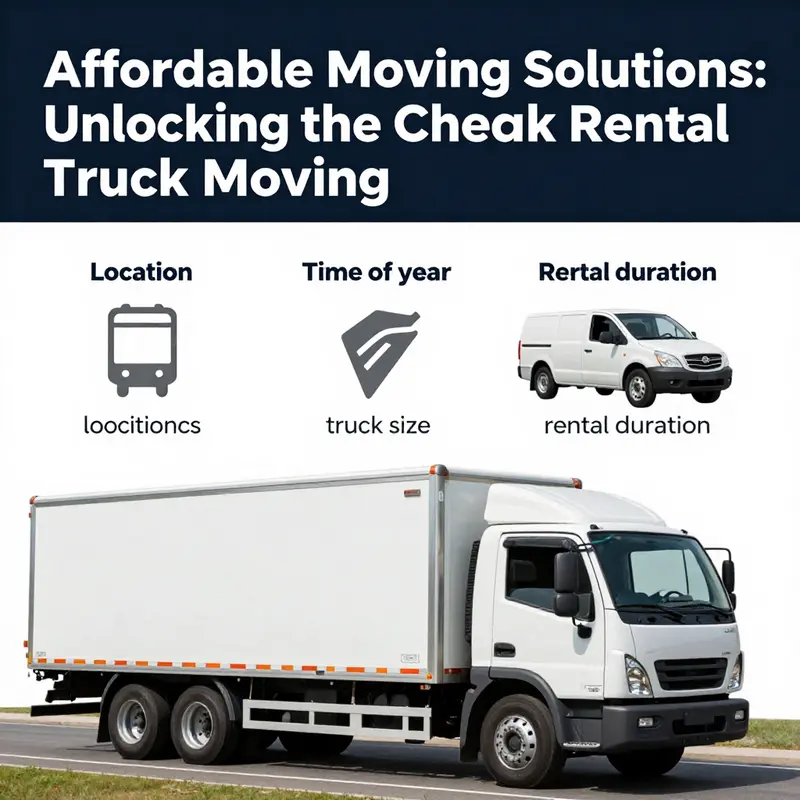
Sizing Up Savings: How Vehicle Choice and Timing Shape the Cheapest Truck Rental for Moving
Every move starts with a budget, but the path to a cheap truck rental is not a straight line. It unfolds through a dance of size, duration, season, pickup location, and the fine print of fees. The goal is not to squeeze into the smallest possible vehicle and call it a win, but to match the truck to the actual load, the timing of the request, and the realities of the rental market. When you step back, the cheapest option often means choosing a vehicle that is just large enough for your belongings, locking in a rental window that spreads fixed costs across more days, and steering clear of peak demand and surprise charges that quietly inflate the bill.
Size matters more than most people expect. The most obvious lever to pull is the vehicle’s capacity. A compact box truck or a basic cargo van may seem small, but it aligns closely with a modest load. In practical terms, local moves that involve the contents of one or two rooms are typically well served by a vehicle in the 10- to 15-foot range or by a small cargo van. In this tier, daily rates can hover in a friendly band—roughly from $30 to $70 per day, depending on the exact model, the location, and the rental policy. The upside is straightforward: you avoid paying for empty capacity. You pay only for the space you actually fill and the few hours you need to maneuver it.
But when the load pushes beyond that cozy threshold, the cost curve rises quickly. A larger, 26-foot box truck—commonly used for bigger moves or longer legs of a relocation—can push the daily price well past the hundred-dollar mark. In some situations, daily charges can climb toward $200 or more, especially if the rental is in a high-demand region or during peak times. The practical implication is clear: renting a truck that is too big for the job is a costly misalignment of purpose. It’s not merely about space; it’s about wasted fuel, heavier insurance requirements, and more tiresome driving for a driver who must navigate a larger vehicle through tighter urban streets.
The ability to size the truck precisely to your load is the most potent cost control. To move efficiently without overpaying, begin with an honest appraisal of what actually fits. Lay out the items, measure the largest pieces, and map a floor plan of how you intend to stack and secure belongings. If you own a few bulky items that can be dissassembled or placed in a vertical stack, you may squeeze into a smaller truck than you fear. A carload of furniture can often be arranged carefully into a compact box truck or a well-organized cargo van when placed strategically. Conversely, if you cling to a larger vehicle because you anticipate a future space for unexpected items, you risk paying for unused capacity and extra mileage.
Beyond the bare payload, consider the vehicle’s design and features. A newer, cleaner vehicle might feel more comfortable to drive and easier to load, but price differences can exist even for similarly sized models. In some markets, local providers price similar-sized units differently based on their fleets, maintenance histories, and how aggressively they advertise seasonal promotions. The practical takeaway is simple: collect an accurate picture of what you need, then price the smallest suitable unit that satisfies that need. It’s a trade-off between ease of loading and thrift, and the best balance is often found by treating the size decision as a core part of the moving plan rather than an afterthought.
The second major lever is rental duration. The cost calculus shifts significantly as you move from a one-day scramble to a more extended schedule. Short-term rentals—think 1 to 3 days—typically carry higher daily rates. The reason is straightforward: fixed operational costs still need to be recouped, and they’re spread over a smaller number of days. If your schedule allows, extending the rental to a week or longer can reduce the daily burden, bringing the per-day rate down through bundled pricing and discounts that many providers offer to longer-term customers. A longer horizon also reduces the pressure to rush loading and unloading, which can prevent damage to both your possessions and the truck. It can also help you avoid last-minute penalties for late returns or for extra hours spent at a loading dock where time is literally money.
In practice, a short move of a few items in a single afternoon may be best served by a local mover who operates on an hourly basis rather than a full truck rental. When you factor in labor plus transportation, this approach can be more economical than renting, fueling, and driving a truck for a limited distance. For certain short-distance transitions, the total cost collapses if you choose to combine transportation with labor in a single service package. The numbers in studies and field reports tend to converge on a similar pattern: for modest loads, a brief truck rental can be economical, but for slightly larger loads or even modest distances, a move-by-labor-and-transport service can flag a lower total price.
Time of year and day of the week is the third axis on which savings hinge. Demand for moving trucks peaks in late spring through summer and often peaks again on Saturdays, when many households schedule their relocations. Autumn and winter are the off-peak seasons, when fleets are less constrained and rental desks are quieter. If you can decouple your move from a weekend and pick a weekday—particularly Tuesday or Wednesday—the odds of landing a lower rate rise noticeably. In less crowded months, rental companies may also extend promotions that lower the daily base rate or waive certain fees to attract customers who, otherwise, would shop around elsewhere.
Location and pickup or drop-off points form a fourth dimension of price. Urban centers and places with high population density typically carry higher rates. The reasons are familiar: greater demand, higher operating costs, and a higher likelihood of tolls, parking fees, or special drop-off charges. Conversely, rural or smaller towns often offer more forgiving price tags. The site of pickup can also carry its own tweaks. A central depot might offer cheaper access, whereas airport-adjacent or downtown pickups frequently incur surcharge fees. If you’re flexible about where you start and end, you can shave dollars by selecting a nearby alternative depot. The most careful planners also confirm whether a pickup or drop-off at a nonstandard site could trigger a relocation fee or a special handling charge that erodes the savings you counted on.
Hidden costs are the fifth factor you must confront. The base rental price is only the opening bid. Once you leave the counter, the bill can grow through mileage charges, fuel policies, insurance packages, and potential waivers. Some companies require you to return the vehicle with a full tank; others offer a pre-purchased fuel option but then bill you a premium for refueling. Mileage is a minefield—some plans include a generous allowance, others charge per mile beyond a fixed limit. Insurance is another common source of surprise charges, especially if you opt for comprehensive protection or purchase add-ons that seem prudent but multiply the daily cost. The trick is to choose a plan that aligns with your risk level and anticipated driving, not one that covers every hypothetical scenario. If you think you might exceed the mileage cap or if you’re unsure about fuel consumption, a plan with a reasonable unlimited mile option can prevent a later sting.
The sixth factor concerns the rental company and the vehicle’s condition. National chains often present standardized pricing, which is comforting for predictability but not always the cheapest. Local providers may offer aggressive introductory rates to capture a broader pool of customers, sometimes with newer or better-maintained fleets. It’s tempting to chase the lowest price, but a vehicle in poor condition can lag costs in ways that aren’t immediately obvious: more frequent refueling, higher maintenance risk, and potential delays if the truck breaks down mid-move. A fresh, well-maintained fleet may carry a slightly higher daily rate, yet the reliability and lower risk of hidden costs can translate into real savings over the course of a move. The lesson is practical: ask about maintenance practices, inspect the vehicle for condition issues, and read the rental agreement with careful attention to mileage, fuel, and insurance terms. A little diligence up front can prevent expensive misconfigurations later.
The net of these six factors is not a single universal rule but a set of guiding principles. The cheapest truck rental for a given move emerges when the vehicle size is matched to the actual load, the rental duration leverages the best possible per-day rate without creating time pressure, and the timing and location of the rental align with off-peak demand and lower overheads. The result is a plan that minimizes waste—of space, fuel, time, and money.
To illustrate how these pieces fit together, imagine a modest move from a small apartment to a nearby apartment in a town that isn’t at the center of a large city. The items fit neatly into a 12- to 16-foot box-truck-sized space, no heavy equipment needed beyond blankets and basic tie-downs. You choose a weekday in winter, when roads are clear enough and rental desks are quieter, and you pick up from a suburban depot rather than downtown. You extend the rental to a full week to spread the fixed costs and lock in a lower daily rate, while you plan a slow and careful loading schedule that minimizes fuel usage and keeps the truck running smoothly. The total bill remains within what you would expect for a single day of renting a larger truck in peak season, and you avoid the price spikes that arrive with last-minute, weekend, or peak-time moves. This pragmatic approach—matching size to load, extending the rental period to reduce the daily rate, and choosing off-peak timing—often yields the most sustainable savings.
As you consider the options, a practical step is to source a quick comparison of deals that emphasizes both price and value. A dedicated page focused on discounts and promotions for truck rentals can help you sort through bevy of offers without getting overwhelmed by the fine print. For readers who want to explore current pricing and potential promotions in one place, a concise overview of discounts on truck rentals can be a useful waypoint. discounts on truck rentals offers a focused starting point to see how promos stack up against standard daily rates and how they apply across vehicle sizes. This kind of resource helps you validate the path you plan to follow and avoid missing a limited-time deal that could tilt the economics of your move a notch lower.
The obvious question that follows is how to translate these general guidelines into a concrete plan. Begin with a careful inventory of your items and a rough estimate of their dimensions. Create a simple map of how you will load the truck, including which items go first, which ones are most fragile, and how you will secure them. If you can spread the move over a few days, you capture not just the lower per-day rate but also the opportunity to optimize your route and loading sequence to minimize trips. If you’re moving within a small radius, you may discover that the difference between a 12-foot and a 16-foot truck is less about capacity and more about maneuverability and comfort in loading. The small margin in choice becomes meaningful when it translates into fewer trips, less time behind the wheel, and reduced risk of damage while transporting your possessions.
In the end, the cheapest truck rental for moving is not a single metric but a combination of factors that collectively lower the cost curve. It’s the art of selecting a vehicle that fits, not overfits, the load; choosing a rental window that spreads fixed expenses across more days; and timing the project to exploit off-peak rates and lower demand. It’s also about recognizing when a full-service moving option, which bundles transportation with labor, can deliver a lower total price for small-to-moderate moves. The most economical choice may be a hybrid approach—use a smaller truck for the core loading and add labor support if and when it makes sense for the items you are moving and the timeframe you are working within. This balanced strategy respects the constraints of budget without compromising the safety and integrity of your belongings.
For readers who want to explore additional angles, the next section continues the thread by examining how one’s local market dynamics—such as fleet composition, regional promotions, and the incentives offered by different rental outlets—can shift the apparent bottom line. It’s not about chasing the absolute lowest posted rate in isolation but about weaving together the size fit, time fit, and space-to-speed considerations into a plan that yields real, tangible savings on moving day. When you can do that, the cheapest truck rental for moving becomes less about chasing a bargain and more about orchestrating a sensible, well-timed, and well-executed logistics plan.
External resource for pricing and availability is available at a widely used moving-truck pricing platform and the broader market. For real-time pricing and availability, see the external resource: Moving truck pricing resource. This reference offers current price fields, rental durations, and general policy outlines that complement the more tailored guidance above.
Final thoughts
In conclusion, being strategic and informed is crucial when seeking the cheapest truck rental for moving your business. By exploring the various rental options available, comparing costs with local moving services, and understanding the key factors that influence pricing, you can significantly reduce your moving expenses. The right approach can not only save you money but also ensure a seamless transition to your new location. Take the time to assess your specific moving needs, and you’ll be well on your way to finding a cost-effective solution that works for you.