
In the competitive landscape of logistics and transportation, fuel efficiency plays a pivotal role in managing operational costs. With Penske Truck Leasing’s latest data revealing an impressive average fuel economy of 7.24 miles per gallon (mpg) for its rental fleets, business owners have a powerful tool at their disposal to enhance efficiency. This article explores the various dimensions of Penske gas mileage, including a comparative analysis with owned fleets, the impact on operational costs, emerging technological innovations, and future trends in fleet management. Each chapter delves into these aspects, providing comprehensive insights that will guide business owners in making informed decisions.
Riding the Savings Wave: The Gas Mileage Edge of Penske’s Leased Fleets
Fuel efficiency sits at the core of the economics of trucking, shaping whether a carrier clears a profit line or trims margins to the bone. In a business where each mile carries a stack of costs—from driver wages to insurance and maintenance—fuel spend often emerges as a dominant variable. The 2026 data from Penske Truck Leasing lands squarely in that tension. It shows a clear efficiency advantage for leased fleets over owner-operator or heavily owned fleets: average fuel economy climbs to 7.24 miles per gallon (mpg) for leased configurations, compared with 6.84 mpg for fleets that own most of their equipment. It might look like a modest difference on a per-vehicle basis, but scale that across a large fleet, and the impact on total operating costs becomes tangible. The contrast invites operators to look beyond sticker price and into the broader system of how equipment is sourced, maintained, and refreshed over time. The implication is not merely about owning the newest model year; it is about how a leasing approach can normalize access to newer, more efficient technologies and standardize performance across an entire fleet.
The efficiency edge of leased fleets, as highlighted by Penske’s findings, arises from a confluence of practical factors that work together to shave off fuel consumption in ways that are hard to replicate with ownership alone. Foremost among these is the regular renewal cycle that comes with leasing. Leased fleets turn over more quickly, enabling a higher probability that each asset in service is a relatively new model. Newer trucks bring advances in aerodynamics, weight reduction, and powertrain efficiency that small, incremental improvements add up quickly on the road. A lighter chassis, optimized transmission strategies, and tighter engine calibration can translate directly into more miles per registered gallon. Even details like more efficient tires and rolling resistance reductions can contribute to sustained gains when every truck in the mix benefits from up-to-date components rather than stagnating with aging parts.
But updating the hardware is only part of the story. The leasing model also lowers barriers to adopting the latest fuel-saving technologies. Modern fleets increasingly rely on integrated telematics, real-time vehicle data, and proactive maintenance triggers to keep engines running at peak efficiency. When a fleet operates on a renewal plan, the incentive to implement these technologies across the board aligns with the supplier’s capacity to deploy and calibrate the systems. Fleet managers can standardize settings—cruise control, idle management, max speeds, and fuel-optimized routing—that compound savings across thousands of miles. The result is not simply a handful of high-performing engines scattered through a lineup; it is a coordinated performance envelope where each vehicle benefits from the same efficiency playbook.
From the driver’s seat, the difference is reinforced by consistency. Leased fleets tend to share standardized equipment and operating practices, which makes training more effective and performance more predictable. When a driver moves from one truck to another within the same lease program, the transition is smoother because the vehicles share common control schemes, feedback indicators, and fuel-saving cues. This uniformity translates into fewer missteps that waste fuel, and more opportunities to leverage best practices that become almost automatic with repetition. In contrast, owned fleets that rely on a mix of aging and newer equipment can face a broader spread of operating characteristics. A single outlier—the oldest asset or an oddball configuration—can drag down overall performance unless it is continually tuned and maintained to the same standard as the rest.
The numbers also reflect a disciplined approach to maintenance and asset utilization. Leasing agreements typically include maintenance provisions and defined service intervals that keep engines, transmissions, and axles operating within their optimal bands. When fleets operate with predictable, timely maintenance, fuel economy does not simply improve as a one-off result of a newer truck; it stabilizes as a standard operating condition. Tires, a critical but often overlooked element of mpg, are rotated and replaced according to a schedule designed to maintain the lowest possible rolling resistance. The effect is a fleet where each mile is produced by machines that work in harmony—engines tuned, tires optimized, and components refreshed on a rhythm that keeps efficiency front and center.
Beyond the mechanical and procedural drivers, the leasing model fosters a more adaptable approach to route planning and utilization. With access to newer, more efficient trucks and the data streams that come with modern equipment, operators can experiment with routing, weight distribution, and scheduling that push fuel economy higher without compromising service levels. In late-hour back-and-forth negotiations on loads or tight delivery windows, the ability to lean on consistently efficient equipment means a company can push for more favorable miles-per-gallon outcomes, even in dynamic conditions. It is not merely about buying fuel economy as a static feature; it is about building a responsive system where vehicle upgrades and data-driven decisions reinforce each other to maximize mileage per gallon over time.
For customers evaluating whether to lease or own, the Penske figures offer a concrete lens on total cost of operation, not just capital expenditure. The incremental mpg gains in leased fleets reduce fuel spend per mile, which, across millions of miles, can be the difference between a competitive bid and a bid that misses. When fuel prices rise or volatility spikes—as they often do in global markets—the value of a more efficient fleet compounds. The savings on fuel per mile accumulate, creating a buffer against cost shocks and enabling more accurate budgeting and forecasting. The leasing pathway, then, becomes not only a means of fleet modernization but a strategic tool for cost control and resilience in the supply chain.
In this light, the distinction between leased and owned fleets becomes a lens on a broader philosophy of asset management. Leasing incentivizes regular refresh cycles, broader standardization, and the rapid adoption of fuel-saving tech across the fleet. It cultivates a culture of maintenance discipline and data-driven optimization that translates into higher mpg and lower fuel spend. These advantages are particularly pronounced in operations that scale, where even modest per-mile gains mount into meaningful annual savings across the entire network. The difference in mpg reflected in Penske’s 2026 report is not a statistical footnote; it is a practical signal of what a proactive, renewal-oriented fleet strategy can achieve in the real world.
For readers who want to explore the specifics of Penske’s analysis in greater depth, a closer look at the fuel-mileage discussion is available in their published materials. As you consider whether to pursue leasing as a strategic approach to fuel efficiency, you can also examine related discussions and data through a wider lens. For a concise, accessible overview of Penske’s fuel-mileage findings, see the Penske Truck Gas Mileage discussion. Penske Truck Gas Mileage. This resource helps contextualize the numbers and clarifies how a leasing model translates into operational realities on the road.
The practical takeaway for fleet managers and operations leaders is straightforward. If your objective is to raise mpg across a multi-vehicle operation while maintaining predictable maintenance and service standards, a renewal-rich leasing strategy aligns well with that objective. The 7.24 mpg figure for leased fleets in 2026 is more than a numerical curiosity; it is a reflection of systemic changes in how fleets are built, managed, and refreshed. The reality is that a well-structured lease program can deliver a cumulative effect that compounds over time—more miles per gallon, lower fuel spend, more consistent performance, and heightened resilience against price volatility. In a sector where marginal gains multiply across dozens or hundreds of trucks, the leverage provided by a modern leased fleet is substantial. It is a reminder that fuel economy is not solely a function of the engine or the tires; it is a property of the entire system—the vehicle, the procedures, the data, and the renewal cadence that keeps the fleet moving forward with efficiency.
External resources provide additional context for readers seeking to situate these results within the broader industry landscape. For a deeper dive into the full metrics and methodology behind the Penske findings, the official report can be consulted. Penske Truck Leasing – Fuel Economy in Leased Fleets (2026).
A Mile Ahead: How Penske’s Rental Fleet Sets the Benchmark in Gas Mileage
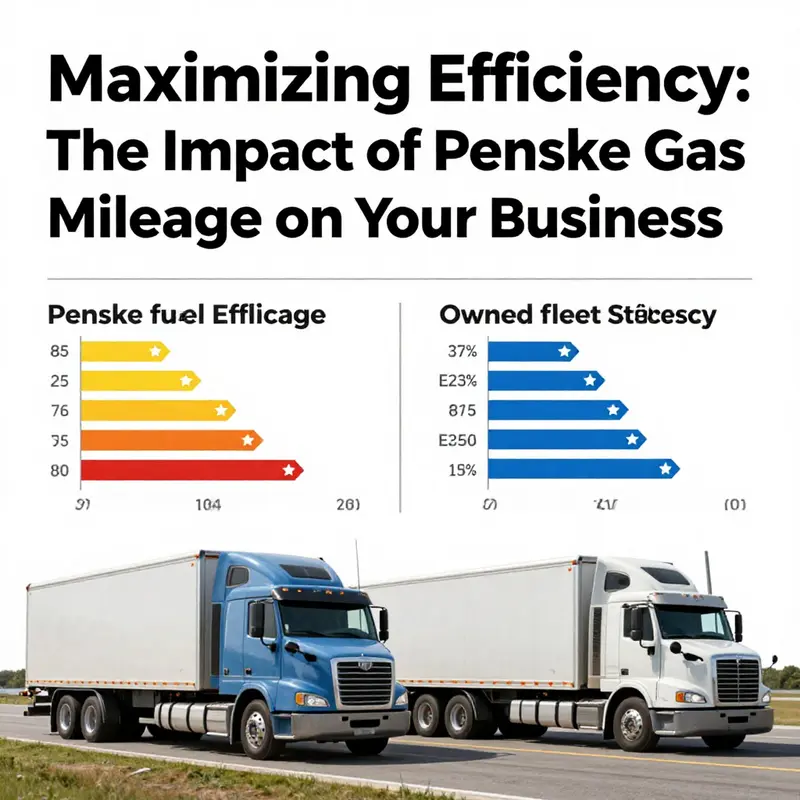
Fuel efficiency is more than a value on a dashboard; it is a reflection of how a fleet is managed, how it ages, and how daily choices compound into lower operating costs. In the freight world, a well-run rental fleet can present a clear advantage in miles per gallon, especially when the fleet is operated by a company that standardizes maintenance, updates vehicles, and adopts drag-reducing technologies across its line. Recent data from 2026 show that Penske Truck Leasing’s rental fleet averages about 7.24 miles per gallon, while fleets that rely primarily on owned equipment hover around 6.84 mpg. The difference may seem modest on a single truck, but it compounds quickly across miles, shipments, and time. For operators chasing lower fuel bills and tighter margins, the implication is simple: disciplined use of a rental partner with a modern, well-maintained fleet can translate into tangible savings, especially when journeys are long, loads are steady, and idling is minimized. This is not merely a trivia fact; it is a practical reminder that fleet strategy must be rooted in maintenance discipline, equipment refresh cycles, and fueling practices as a single, cohesive system rather than a series of isolated decisions.
The reasons behind Penske’s MPG edge are layered and interrelated. First, a rental fleet like Penske’s tends to operate on rigorous maintenance schedules. Engines, transmissions, cooling systems, brakes, and tires are monitored with deadlines that align with mileage thresholds and performance benchmarks. Tire pressure, for example, is not a once-a-year check but a daily expectation, because proper inflation preserves rolling resistance and extends the life of tread. This attention to tires matters because rolling resistance is a direct governor of fuel consumption. When tires are correctly inflated, there is less energy wasted fighting drag and friction on every mile. The payoff is not only better miles per gallon but also more predictable fuel budgeting for customers who rely on fixed-rate or projected fuel costs. In an era when fleets chase precise cost-per-mile figures, the reliability of a well-timed maintenance routine becomes a quiet engine of efficiency.
Second, the make and model mix of a rental fleet tend to skew toward newer, more aerodynamically optimized configurations. Modern trucks are designed to slip through air with less resistance, and fuel efficiency is increasingly a product of engineering choices that optimize drag, engine efficiency, and weight. Technologies such as efficient turbocharged engines, refined transmissions, and even auxiliary power units that reduce idling contribute to real-world mpg improvements. A newer vehicle lineup also benefits from better thermal management and less parasitic load from aging accessories. The cumulative effect is that, on average, rental fleets with refreshed stock can deliver smoother, more economical performance across a wide range of use cases and route profiles.
Yet another layer involves the operational practices surrounding rental use. Rentals are often part of a broader fleet-management ecosystem, where route planning, load optimization, and driver training are integrated into the service model. When a fleet is managed with an eye toward fuel economy, drivers receive guidance and incentives that promote smooth acceleration, steady cruising speeds, and swift but safe route choices. Even modest changes in driving behavior—reducing aggressive accelerations, minimizing excessive idle time, and planning for optimal departure windows—can add up across hundreds of thousands of miles. In the Penske model, the scale of operations helps stabilize these practices. Large fleets can spread fuel-management investments across many units, achieving efficiencies that small, individually managed owned fleets may struggle to reach without substantial capital outlays.
The numbers from Penske’s reported performance illuminate the practical impact. If a customer is renting several trucks for long-haul or high-use periods, the 7.24 mpg average is not just a statistic; it is a baseline around which fuel budgeting can be planned. The comparison with owned fleets reflects a composite of factors—age, maintenance routines, and driver behavior—but even with those differences acknowledged, the rental model stands out as a benchmark for consistency and efficiency. When a fleet relies on older, less reliable vehicles, the risk is that fuel economy can be more variable and more sensitive to maintenance gaps, tire wear, and suboptimal idling. In contrast, a rental provider structured around predictable maintenance windows and newer equipment reduces the likelihood of these drifts, especially on routes that demand repeated performances across many days of operation. The practical implication is clear: for operations balancing cost control with capacity, a rental option backed by a modern, well-maintained fleet can deliver a more predictable fuel profile than a privately owned counterpart, unless that owner makes parallel investments in upgrades, maintenance discipline, and driver training.
To bring this to life, consider how the fuel economy translates into miles and costs in concrete terms. Penske notes that a 16-foot gas truck with a 33-gallon tank can achieve approximately 330 miles when loaded. That figure, while specific to a particular configuration and load, illustrates the dividends of a compact design paired with efficient systems: a moderate tank size, efficient energy use, and a reasonable payload can align to a robust miles-per-tank outcome. For larger, diesel-powered operations that push toward 22- to 26-foot configurations, the mileage per tank tends to extend beyond 500 miles, largely because diesel engines, coupled with advanced engineering for long-distance performance, often deliver higher energy content per gallon and a more economical fuel curve at highway speeds. These examples matter because they translate the abstract concept of mpg into tangible planning tools for dispatchers, fleet operators, and shippers who must forecast fuel needs across fluctuating demand and varying routes.
The implications extend beyond per-truck efficiency and into the total cost of operation. Fuel can be a dominant variable in the total cost-per-mile equation, and even a fraction of a mile per gallon can multiply into meaningful savings when multiplied by tens or hundreds of thousands of miles annually. A fleet that reliably edges out its own mile-per-gallon benchmark reduces fuel expenditure, lowers emissions footprints, and improves on-time performance by reducing the probability of fuel-related disruptions in the middle of a freight cycle. The Penske data underscore the fact that when maintenance and technology go hand in hand with disciplined operations, the fleet can sustain a higher mpg score across diverse use patterns. For operators weighing whether to transition to rental or to rethink their in-house maintenance and procurement strategies, the numbers invite a deeper appraisal of how a standardized fleet approach can unlock long-term fuel efficiency dividends.
Of course, context matters. The mileage gap between Penske’s rental fleet and a privately owned fleet is not a one-to-one guarantee for every operator. Usage patterns differ; some owners might accrue higher mileage on routes that lend themselves to fuel efficiency through steady highway speeds, efficient routing, and light cargo. Others may experience more variability because of frequent stop-and-go traffic, heavy payloads, or inconsistent maintenance schedules. Still, the overarching takeaway remains robust: investment in regular maintenance, vehicle refresh cycles, and training, combined with access to a modern, well-engineered fleet, aligns with stronger fuel economy outcomes. For many shippers and operators, that combination reduces the risk of fuel-cost volatility and makes capacity planning more predictable across seasons and demand surges.
To explore these ideas further within the broader landscape of fuel management, readers can consult an overview that ties together the practice of fuel economies with fleet design and operational discipline. For a concise reference focused on the practicalities of fuel efficiency in rental contexts, see Penske Truck Gas Mileage. This resource helps translate high-level performance into everyday decisions about how and when to deploy rental assets, how to manage loads, and how to integrate fueling strategy with maintenance planning. Penske Truck Gas Mileage
As a final reflection, the conversation about fuel efficiency in Penske’s rental fleet is not simply about comparing numbers. It is about how a well-structured fleet—one that emphasizes regular maintenance, modern engineering, and disciplined operations—can produce more predictable, reliable, and economical performance over time. In an industry where every mile matters, the value of a gas-mileage edge is not a single data point but a cumulative advantage that accrues across thousands of loads and miles, building a case for rental partnerships as practical tools for achieving cost efficiency and operational resilience. For readers seeking additional validation and context about fuel-management standards that inform these outcomes, the external resource offers a detailed perspective on how fleets implement fuel-saving practices at scale: https://www.penske.com/truck-leasing/fuel-management/.
null
null
Riding the Numbers: How Technology and Design Elevate Penske’s Gas Mileage
Gas mileage in large commercial fleets is more than a single metric; it is the result of an orchestrated blend of data, design, and disciplined operations. In Penske’s fleet, there is a meaningful gap in fuel economy between rental vehicles and those with a larger share of owned equipment. For example, the rental fleet averages about 7.24 miles per gallon, while fleets with more self-owned equipment hover near 6.84 mpg. These numbers reflect a deliberate, technology-driven approach to fleet management that treats fuel efficiency as a strategic performance metric rather than a byproduct of vehicle choice. This chapter traces how data, engineering decisions, and operational practices converge to push Penske’s gas mileage higher and, with it, customer value.
At the core lies an integrated analytics engine that turns raw telematics into actionable guidance for drivers and managers. Penske’s Catalyst AI platform operates as a central nervous system for the fleet, collecting streams of data from thousands of assets and translating them into concrete steps. From fuel-efficiency trends to maintenance costs, the system paints a dynamic picture of how vehicle, route, and driver groups contribute to the overall fuel picture. The value comes not only from spotting what went wrong after the fact, but forecasting opportunities before inefficiencies crystallize into higher costs. Operators can compare driving patterns, track idling durations, and flag early signs of wear that would raise rolling resistance or reduce engine efficiency. When the platform surfaces a pattern—such as a cluster of trips that consistently consume more fuel at certain speeds—the fleet manager can intervene with targeted training, route adjustments, or maintenance changes tailored to that subset. In short, Catalyst AI guides decisions that tilt the balance toward lower fuel consumption over time.
That balance is reinforced by design choices embedded in Penske’s vehicle lineup. The gains come from three levers: optimized tire selection, rear-axle ratios, and aerodynamic enhancements. Each lever addresses a fundamental driver of fuel use. Rolling resistance, influenced by tire compounds and tread designs, can be reduced without compromising traction or durability. When paired with a rear-axle ratio that favors efficient highway cruising, the vehicle can sustain energy-efficient momentum over long segments of travel, translating into more miles per gallon. Aerodynamics play a parallel role by smoothing air flow around the tractor and trailer, diminishing drag that would otherwise steal energy from the engine’s output. These are practical, repeatable choices that fleet operators can rely on as part of a broader, continuous improvement program. The combination of tires, gearing, and aerodynamics creates a baseline of efficiency that supports higher mpg across the fleet, especially when paired with disciplined driving practices and proactive maintenance.
A parallel line of action is the use of auxiliary power units to curb engine idling. When trucks rest at warehouses, terminals, or loading zones, idling can account for a non-trivial share of daily fuel consumption. APUs offer a practical alternative here, powering climate control and essential electrical needs without idle-time fuel burn. In environments with prolonged stops—loading windows, cross-docking cycles, or long layovers—the incremental fuel savings from APUs accumulate, sometimes substantially, across a fleet of thousands of vehicles. This approach does more than save fuel; it reduces emissions and smooths the maintenance burden on primary propulsion systems. With engines off for longer periods during downtime, wear on the engine and exhaust aftertreatment systems can be better managed, contributing to more consistent fuel economy over the vehicle’s life.
The interplay among data-driven insights, vehicle design, and idle-reducing technologies yields a holistic energy strategy. It is difficult to overstate how the synergy works in practice. The Catalyst AI platform identifies specific, actionable targets—patterns of acceleration, braking, and idling—while the engineering choices in tires, gearing, and aerodynamics create a physical substrate that makes those targets achievable. When drivers receive feedback from the analytics system about how to adjust their habits or how to exploit certain vehicle configurations on particular routes, the organization translates those lessons into training and scheduling practices that reinforce efficient behavior. In this sense, fuel economy becomes a shared responsibility that travels from the data center to the cab, and then onto the road, where each mile is earned through a blend of intelligent planning and disciplined execution.
From a customer perspective, the implications are tangible. A fleet that consistently improves its fuel economy can offer lower operating costs, tighter delivery windows, and greater reliability in energy-intensive logistics scenarios. It also aligns with broader sustainability goals that shape procurement decisions and carrier selection. The data indicating higher mpg in rental over owned equipment suggests rental vehicles are not only newer but better optimized for efficiency through ongoing modernization and system-wide refinement. The rental fleet may benefit from regular refresh cycles, allowing Penske to incorporate the latest aerodynamic devices, tire technologies, and power management systems as standard enhancements—an advantage that translates to real-world fuel savings for customers who rely on flexible, short-term transportation solutions.
The narrative of Penske’s gas mileage is a narrative of prudent operational discipline. Fuel efficiency is the result of a continuous optimization loop that tightly couples data insights with maintenance planning, driver coaching, and asset design. Every improvement in tire selection or axle ratio is validated in the context of its impact on miles per gallon, maintenance overhead, and reliability. And every opportunity surfaced by Catalyst AI becomes a test case for scaling across the fleet. The chain of cause and effect is long and interconnected: improved tire rolling resistance reduces fuel burn on highway runs; that reduction, when amplified by a gearing configuration that favors higher cruising efficiency, lowers engine load and thus fuel consumption; cleaner aerodynamics reduce drag and further free up energy to propel the vehicle without increasing engine load. When these elements align, the result is a fleet that travels farther on the same amount of fuel, a capability that directly benefits customers who need predictable throughput and cost stability in their transportation partnerships.
The conversation around fuel economy in a Penske context would be incomplete without noting how customers can engage with these capabilities. For instance, Penske emphasizes fuel efficiency not merely as a corporate concern but as a practical lens through which customers evaluate total cost of ownership and total miles delivered per dollar. By choosing a fleet that benefits from data-driven optimization, customers gain access to smoother total cost curves and a more predictable fuel spend profile, even as freight demands fluctuate. The integration of Catalyst AI insights into daily dispatch decisions helps ensure that the most efficient vehicle is selected for a given route, while the maintenance schedule is aligned with wear patterns that most affect mpg. In essence, customers come to rely not only on fleet capacity but also on refueling consistency and the ability to minimize waste across the logistics chain. See the Penske gas mileage page for a concise entry point into the ongoing dialogue about how fleets can bend the curve of fuel consumption through smart decisions and smart technology. https://larentaltrucks.com/blog/penske-truck-gas-mileage/
External resources continue to illuminate the landscape of fleet fuel efficiency beyond a single fleet, with independent benchmarks and guidance that help contextualize Penske’s approach within broader industry trends. For a comprehensive external reference on how fleets evaluate and manage fuel economy, see the linked resource on fleet fuel economy and related performance metrics at https://www.fueleconomy.gov/feg/fleet.shtml
Riding the MPG Wave: Predictive Analytics, Connected Data, and the Future of Penske Gas Mileage
Fuel economy is more than a number on a dashboard. It is a living thread that ties together equipment, maintenance, driver behavior, routes, and the invisible but powerful intelligence of data. In the current climate of freight movement, the Penske Truck Leasing benchmark—7.24 miles per gallon on a rental fleet, compared with 6.84 mpg for fleets that rely mostly on their own assets—offers a window into how fleet management is evolving. Those two figures, while seemingly simple, encode a spectrum of practices that together tilt a fleet toward efficiency and lower total operating costs. The rental fleet advantage suggests that when a fleet is continuously refreshed, routinely serviced, and supported by a service architecture that emphasizes uptime, fuel economy improves. The numbers imply more than better engines or lighter trailers; they reflect a system where maintenance, technology, and a disciplined approach to operations converge to reduce the gallons burned per mile and the dollars spent per ton moved. In that sense, Penske’s fuel-economy performance is not merely a product of newer hardware but of a holistic strategy that treats fuel efficiency as a core performance metric rather than a side benefit.\n\nCentral to this strategy is the steady integration of predictive maintenance and AI-driven insights. In 2025, Penske underscored a shift in fleet management toward tools that anticipate failures before they occur, optimize uptime, and thereby preserve the engine’s efficiency envelope. When a vehicle is idle less, runs more smoothly, and experiences fewer on-road surprises, it consumes fuel more consistently. Predictive maintenance helps fleets avoid the fuel-wasting consequences of sudden breakdowns, such as extended idling, detours for repair, and erratic driving patterns that spike fuel usage. The promise is clear: by combining data streams from engines, transmissions, tires, and fuel systems with sophisticated analytics, fleets can operate with a tighter control loop. The effect on MPG can be substantial because efficiency is not only about what the engine produces but about how the entire vehicle system behaves under real-world duty cycles. Penske’s emphasis on uptime translates into more predictable power performance, which in turn stabilizes miles-per-gallon metrics across the fleet.\n\nThe role of connected data platforms and telematics cannot be overstated in this narrative. By 2026, industry operators expect fleets to move past static route planning and into continuous optimization guided by real-time performance signals. When a fleet can observe engine load, speed, idle time, and ambient conditions as a single coherent data fabric, it becomes possible to prune inefficient patterns with surgical precision. For Penske, the implication is that driver coaching, route selection, and maintenance scheduling are no longer separate disciplines but components of a unified optimization engine. Real-time feedback on fuel consumption tied to specific routes and loads allows a fleet to compare performance across different configurations, such as varying payload distributions or seasonal temperature effects, and to modulate decisions accordingly. The result is a more resilient fuel economy profile that adapts to evolving operating environments while preserving asset value.\n\nOutsourced maintenance has emerged as a parallel pillar of this optimization. The model where fleets rely on specialized diagnostics and modern service capabilities for routine and advanced maintenance—not only speeds up repairs but enhances the quality of those interventions—supports fuel economy in several ways. First, expert technicians bring advanced equipment and latest diagnostic capabilities, ensuring engines and fuel systems operate within design tolerances longer. Second, outsourced teams can coordinate with telematics to schedule maintenance before a potential issue escalates into a fuel-inefficient condition, such as clogged filters, suboptimal air intake, or stale fuel systems. Third, because outsourced maintenance often aligns with a broader service network, downtime is minimized, and vehicles spend more hours on the road delivering efficiency gains rather than idling in yards. The alignment of maintenance with data-driven insights creates a virtuous cycle: improved engine health supports stable fuel economy, while real-time data highlights opportunities to tune performance, further enhancing miles per gallon.\n\nA broader industry backdrop reinforces the plausibility and desirability of these trends. Across the freight ecosystem, there has been a sustained push toward engines capable of higher thermal efficiency, cleaner fuels, and smarter propulsion strategies. While specific product names and pilot programs belong to a larger competitive landscape, the underlying takeaway remains consistent: technology-enabled improvements in engine technology and alternative or cleaner fuels have demonstrated the potential to raise freight-ton efficiency and curb emissions. The efficiency gains are often assessed in CO2e terms per ton-mile, a metric that captures both energy use and the load carried. In this broader context, rental fleets that regularly refresh and maintain equipment—and that embed predictive maintenance and telematics into their core processes—are well positioned to translate these industry advances into tangible MPG improvements. In other words, the Penske data point of 7.24 mpg on a largely rental fleet is not an isolated anomaly; it is a reflection of a broader trajectory toward higher efficiency, underpinned by smarter maintenance, better data, and deliberate operational practices.\n\nThe implications for customers who rely on Penske’s fleet solutions extend beyond a single mpg figure. A fleet that embeds predictive analytics into daily operations is more capable of sustaining higher fuel economy over time. Predictive maintenance reduces the probability of unexpected engine performance dips that spike fuel burn. Telematics and real-time monitoring enable precise identification of fuel-wattening culprits—unusually aggressive acceleration, excessive idling, suboptimal gearing, and route backlogs that force longer trips with heavier loads. When these signals are translated into actionable steps, fuel usage per mile can fall even as miles traveled rise, or when equal miles are logged, the fuel saved per mile compounds over longer horizons. The comparative advantage of a rental fleet with a higher mpg baseline—7.24 versus 6.84—also underscores the quality of the support system surrounding the vehicle. It is not solely about new hardware; it is about ongoing maintenance discipline, rapid issue resolution, and a network that aligns service delivery with the demands of efficient operations.\n\nFor operators who consider switching to a Penske-enabled model, the logic becomes more practical. A fleet that relies on connected data and predictive maintenance can forecast the marginal gains from a given route or load configuration. It can estimate fuel costs with greater precision, which in turn informs pricing, tendering, and capacity planning. In turn, customers can design contracts and service levels that preserve and extend the efficiency gains achieved by the fleet, ensuring that higher mpg translates into real-world cost savings. As the industry continues to tighten the link between fuel economy and total cost of ownership, the value proposition of a service-oriented fleet partner becomes clearer. The main takeaway is that fuel efficiency is not a one-off improvement but a sustained outcome of disciplined maintenance, contemporary data platforms, and proactive operations management.\n\nTo readers who want a tangible handle on how these concepts translate into daily practice, a closer look at Penske’s public-facing insights on fuel mileage can be illuminating. The organization emphasizes that fuel efficiency benefits arise from a convergence of factors: a refreshed equipment mix, rigorous preventive maintenance, disciplined driver performance, and the tactical use of data to optimize routes and loads. This convergence does not happen by accident. It is engineered through a management philosophy that treats uptime, fuel economy, and asset utilization as interdependent levers. The evidence in the 7.24 mpg vs. 6.84 mpg comparison is a snapshot of this philosophy in action. It invites operators and researchers to consider how an integrated approach—where maintenance, analytics, and operational decisions are aligned—can produce enduring improvements in fuel economy across fleets with varying ownership structures.\n\nFor readers seeking more direct discussion of Penske’s fuel mileage approach within the broader landscape of fleet management, see the detailed examination of Penske’s gas mileage practices at Penske Truck Gas Mileage. This internal reference highlights practical considerations for fleets evaluating fuel economy strategies and serves as a bridge to the broader themes discussed here. https://larentaltrucks.com/blog/penske-truck-gas-mileage/ \n\nAs the sector moves toward 2026 and beyond, the practical convergence of connected data, predictive maintenance, and outsourced expertise will likely become the default for fleets aiming to sustain gains in MPG. The drive toward more intelligent fleet management—where every mile traveled is informed by real-time feedback and long-range planning—will continue to shorten the gap between theoretical efficiency gains and actual fuel savings. The synergy among uptime, route optimization, and fuel economy will likely magnify as data platforms mature, more drivers are trained under data-informed coaching, and maintenance networks expand their reach to support a wider range of equipment in service. The result will be a transportation ecosystem where the MPG metric is less a static benchmark and more a dynamic signal, continuously steered toward lower emissions, reduced fuel spend, and higher asset utilization. The broader industry trend, reinforced by pilot programs and cross-industry collaborations, suggests that the miles-per-gallon frontier will keep advancing as technology, data, and service models align more closely with the economics of freight movement.\n\nFor further evidence of how AI and digital services underpin these advances, external readers can consult a recent Penske insights piece that references the integration of AI and digital services in keeping Penske ahead in a changing fleet landscape. The article, published in early 2025, provides context for how predictive analytics, maintenance optimization, and connected services together form the backbone of modern fleet efficiency. External link: https://www.penske.com/insights/driving-the-future-how-ai-and-hitachi-digital-services-keep-penske-recognized
Final thoughts
Understanding the fuel efficiency of Penske’s rental fleets opens up a wealth of opportunities for business owners looking to optimize their logistics operations. By embracing Penske’s superior gas mileage, companies can not only reduce their fuel expenses but also enhance their overall efficiency and sustainability targets. As we look towards the future, the integration of technology in fleet management will likely further elevate the advantages gained from Penske’s offerings. The insights presented in this article underline the importance of making informed decisions towards fuel-efficient solutions in today’s dynamic market.