
As a business owner utilizing rental trucks for operations, understanding the complex tapestry of weigh station regulations is crucial to ensuring compliance and avoiding penalties. The rules surrounding whether rental trucks must stop at weigh stations can vary significantly from state to state and depend on a variety of factors including the truck’s weight and the nature of its use. Each chapter of this guide delves into essential components: the first outlines state regulations and requirements, the second dives into the importance of Gross Vehicle Weight Ratings (GVWR), and the final chapter emphasizes obligations for commercial use. This comprehensive approach will equip business owners with the knowledge necessary to navigate weigh stations smoothly and make informed decisions regarding their rental truck operations.
Weighing the Miles: How Rental Trucks Align with State Weigh Station Rules
Moving day usually starts with a simple plan: load the truck, drive to a new home, and return the vehicle when the lease ends. But when the rental truck you use carries weight like a commercial vehicle, weight limits become a real factor. Weight compliance helps protect road surfaces and bridges, and it reduces delays or fines if you are stopped at a weigh station. The basics are straightforward: know the truck’s GVWR and axle limits and keep the loaded weight below those thresholds. If you exceed the limit, penalties may include fines, delays, or even impoundment in extreme cases.
Weight thresholds and classification matter because a rental truck is considered for weigh station screening once loaded. Most trucks have a GVWR that defines max payload and axle weights. When cargo pushes the total weight over a threshold or when used for commercial purposes, it is more likely to encounter screening, just like a larger moving truck.
Weigh stations come in two primary forms: static weighing where the vehicle stops on a scale, and weighing in motion, or WIM, which sensors measure trucks as they pass. WIM can quickly separate likely compliant vehicles from suspect ones, but a stop can still occur for a closer inspection. Officers may weigh, measure, and verify compliance and may instruct loading changes or route adjustments if violations are found.
Enforcement is about safety and infrastructure protection, not city busting. Deputies and transport agents use training and discretion; some states require weigh checks in certain situations, others screen more selectively. For renters, this means a planned move may include a weigh station encounter, especially on longer routes or across state lines. The practical advice is simple: check weight before departure, recheck after loading, and plan routes that avoid overweight screening where possible.
For more context, federal guidelines from the FHWA explain how states implement weight rules and weigh stations.
Weighing the Moving Equation: GVWR, Weigh Stations, and the Rules Guiding Rental Trucks
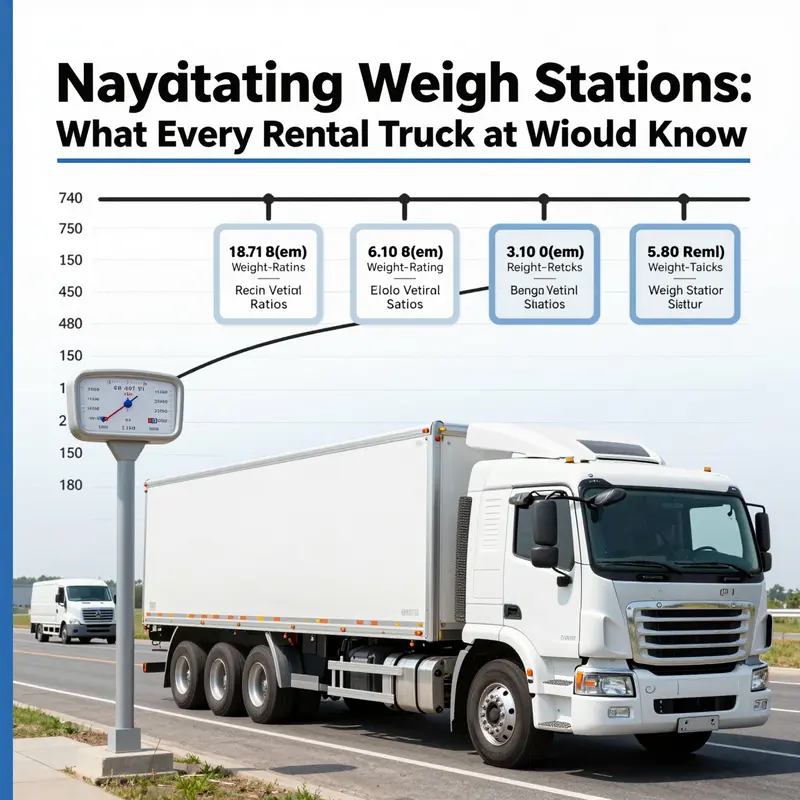
The moment a rental truck leaves the lot, weight becomes more than a simple number on a label. It is the physics of moving cargo safely and the set of rules that keep roads from becoming a rolling hazard. The key driver in this landscape is the Gross Vehicle Weight Rating, or GVWR—a single figure that tells you how much weight the vehicle is designed to carry, including its own weight, passengers, cargo, fuel, and fluids. For anyone planning a move with a rental truck, understanding GVWR isn’t a bureaucratic formality; it is a practical safeguard that determines where you can drive, when you must stop, and what happens if the scale reveals you have crossed the line. Weigh stations, those serried ranks of scales and inspectors that punctuate highways, are not merely checkpoints. They are the enforcement mechanism that translates GVWR into real-world consequences on the road.
GVWR is set by the manufacturer and is typically listed on a label on the vehicle—often on the driver’s side B-pillar or within the owner’s manual. It is the maximum safe weight the vehicle can carry, not just in total, but also in terms of weight distribution across axles. That distribution matters because the brakes, steering geometry, suspension, and overall stability of a commercial vehicle depend on how the weight sits on each axle. When a rental truck is loaded, the crew must ensure that the actual load does not push the vehicle past this rating. If the GVW—the actual gross vehicle weight at any moment—exceeds the GVWR, the truck becomes technically overloaded. The safety implications are not theoretical. Overloads can lead to delayed braking, excessive tire wear, longer stopping distances, and increased risk of axle or suspension failure. On the scale, these risks translate into real penalties: fines, detentions, or in the worst cases, the load being refused passage until it can be redistributed or reduced.
The practical upshot is that the GVWR helps define whether a rental truck is treated as a commercial vehicle and subject to the string of inspections that accompany commercial status. Federal guidelines do not exist in a vacuum; they align with state rules that govern weigh stations and commercial motor vehicle operation. In many places, trucks with a GVWR above 10,001 pounds are considered commercial vehicles for regulatory purposes, triggering periodic inspections under programs administered by federal and state authorities. Those inspections, often conducted under the auspices of the USDOT or the Commercial Vehicle Safety Alliance (CVSA), are designed to verify vehicle safety, tire condition, brake performance, lighting, and, critically, weight compliance. The inspections can happen at weigh stations across the country as part of routine enforcement or as part of mandatory inspection cycles.
For renters, this means that simply loading up a truck and heading out is not enough. The GVWR provides the ceiling. The curb weight—the truck’s own weight when empty—gives the baseline from which you calculate payload. Payload is the difference between the GVWR and the curb weight. If your load pushes the total toward or beyond the GVWR, you are operating on borrowed air. Suddenly the scale at a weigh station becomes more than a checkpoint; it becomes the gatekeeper of your move. If a truck exceeds its GVWR by even a small margin, inspectors can flag the vehicle for further review, require adjustments, or, in some cases, detain the vehicle until the load is reduced and redistributed. The consequences extend beyond money. A delay on the highway can ripple into missed deadlines, rearranged plans, and an anxious exchange with customers or family members waiting at the destination. In other words, GVWR is not a bureaucratic label; it is a practical safety standard with real-world implications for timing, safety, and legal compliance.
The separation of GVWR from gross vehicle weight is a fundamental distinction many renters overlook. GVWR is a rating set by the manufacturer. The actual weight at any moment—the gross vehicle weight, or GVW—reflects the current payload, fuel, passengers, and accessories. While GVWR indicates the safety ceiling, GVW provides the actual load the truck is bearing. When weigh stations measure weight, they are interested not only in the total but in distribution. A truck can be nominally within its GVWR yet still pose a risk if weight is concentrated on a single axle, causing brake overheating or steering instability. The CVSA inspections and weigh-station protocols are designed to catch these nuanced issues, not merely to count pounds. This is why the distribution and the total matter. It is also why the labeling on the vehicle—the GVWR sticker—must be accurate. The National Highway Traffic Safety Administration has underscored that incorrect GVWR labeling is a safety defect. A recall or replacement of a mislabeled truck could be enacted to prevent drivers from unknowingly overloading a vehicle that appears compliant on the surface. A recall example from 2025, while not involving every rental truck, serves as a cautionary tale: a mislabel can lull a driver into exceeding capacity because the published rating fails to reflect the vehicle’s true capacity.
What does this mean on the road for a typical move? For most rental trucks, the practical steps are straightforward, but they require attention to detail. First, locate the GVWR on the B-pillar label or in the manual. It is not a guess. Second, determine the curb weight of your specific truck—this is the weight of the truck when it is empty, including fuel but without passengers or cargo. Subtract the curb weight from the GVWR to obtain the payload you can legally and safely carry. If you are loading a heavy set of furnishings or boxes, you will want to map out the load so that the heaviest items sit near the center and evenly distribute across the front and rear axles if possible. The axle-weight distribution is not endless; it is a practical distribution problem, and mismanagement can trigger a scale reading that triggers an inspection or a detention.
These regulatory mechanics have both federal and state dimensions. The federal requirements for commercial vehicle safety, including the mandate for annual inspections for vehicles above the GVWR threshold, operate in tandem with state programs at weigh stations. Some states implement broader rules, requiring mandatory stops for certain vehicle classes, while others require stopping only if an enforcement officer has reason to suspect a violation. This is not a contradiction; it is a mosaic of enforcement that reflects the safety priorities and road networks of different jurisdictions. For a renter planning a cross-country move, the best practice is to review the specific rules of every state you plan to traverse and to prepare for variability. A quick check of authoritative resources, such as the federal FMCSA guidance and state transportation websites, can provide a roadmap for where you might encounter mandatory stops or additional inspections.
But how does this translate into day-to-day renting and driving? Consider a typical cross-state move where the rented truck is used for business or for a one-time moving project. If the GVWR is set at 10,001 pounds or more, federal guidelines often require regular, USDOT-certified inspections or CVSA inspections. These inspections are not a test you pass at the door; they are ongoing safety checks designed to ensure that all components—the brakes, tires, lights, and load distribution—function within safe limits. A truck that fails an inspection can face penalties, delays, or even the denial of entry onto certain highways until issues are resolved. In practice, this means that inconsistent loading or an overloaded truck may trigger a stop at weigh stations, where inspectors will verify the weight and the distribution of that weight. In a worst-case scenario, a vehicle may be detained and the load reduced to within legal limits, concluding the incident with a warning, a penalty, or a longer delay.
A practical takeaway for renters is to treat GVWR as a variable you manage actively rather than a fixed parameter you hope you never meet. Before loading, verify the GVWR label, estimate the payload, and plan your route with possible weigh-station stops in mind. If you suspect that your load might push toward the GVWR, consider rearranging items, moving some items to a second vehicle, or choosing a smaller truck with a lower GVWR. Being proactive can transform a potential roadblock into a routine stop—one that passes with minimal friction rather than a conflict that derails plans.
An important nuance concerns the difference between GVWR and the actual weight you can legally carry. The weight you can legally carry is a function of the GVWR, the vehicle’s curb weight, and the axle-specific limits that state regulations may impose. CP-systems at weigh stations can measure both the total weight and the weight on each axle. If a truck is heavy overall but well balanced across axles, it may pass more easily than a lighter but poorly balanced load. This is not a loophole; it is a reminder that safe operation hinges on weight distribution as much as on total load. A well-distributed payload reduces the risk of mechanical failure and improves braking response, which is critical when stopping on a grade or maneuvering through congested weigh-station approaches.
To help renters make sense of these rules in real words, consider the practical steps you can take before you depart. First, confirm the GVWR on the vehicle label. If you are uncertain about whether the label reflects the actual capacity, request confirmation from the rental agency before loading. If there is any inconsistency between the label and the vehicle’s capacity, treat the discrepancy as a safety defect and document it. Second, assess the empty weight or curb weight of the truck and subtract that from the GVWR to determine maximum payload. Third, plan the load to ensure the heaviest items are placed in a way that maintains balanced axle loads. If you plan to move and are uncertain about distribution, consider renting a vehicle with a rating that accommodates your expected payload, or plan for additional manpower to help with careful loading and careful staging.
The connection between GVWR, weigh stations, and safety becomes even clearer when we consider the broader regulatory framework. The U.S. Department of Transportation, through the Federal Motor Carrier Safety Administration, provides guidance on vehicle inspections and maintenance. The essence of these guidelines is not about punishing drivers; it is about keeping the road safe for everyone by ensuring that vehicles that travel on public highways maintain certain safety standards and operate within their designed capacities. The underlying science is simple: overloading a vehicle changes its dynamic response, braking efficiency, steering control, and tire wear profile. A scale or a trained inspector can detect anomalies that could predispose a truck to brake failure or loss of control in a difficult maneuver. When a rental truck arrives at a weigh station, the goal is a routine, predictable assessment that confirms the vehicle is within safe limits and adequately maintained. The emphasis on GVWR, payload calculation, and proper labeling is a reminder that safety is an ongoing process, not a one-time compliance checkbox.
For readers who want a concrete touchstone to a specific vehicle class, consider the more common rental options and the typical GVWRs they bear. A 16-foot truck, for example, is a common choice for many moves and has well-defined weight characteristics that renters can calculate in advance. The details—dimensions, payload capacity, and actual curb weight—are typically published by rental providers, and understanding them helps avoid the last-minute surprise at a weigh station. For those who want to explore the specifics of a 16-foot truck in more depth, you can refer to a focused guide that discusses the dimensions and payload considerations of that size. This internal resource provides practical context that complements the regulatory framework described here. 16-foot truck guide.
In sum, GVWR is a safety-critical rating that shapes every move you make with a rental truck. It determines whether a vehicle qualifies as a commercial motor vehicle, it frames the inspections you may encounter at weigh stations, and it guides you in planning loads that stay within safe and legal limits. The best approach for renters is proactive, not reactive: verify the GVWR label before loading, calculate potential payload, and design a load that distributes weight across axles as evenly as possible. Keep in mind that state rules vary, and weigh stations may operate under different enforcement policies. A careful pre-move check with a quick state-by-state review can prevent delays and keep the journey on track. When in doubt, lean on official resources, such as the FMCSA vehicle inspection guidelines, to confirm you are aligned with current standards and practices. External confirmation from these sources ensures you are not navigating a moving target but following a tested path toward safe, compliant, and timely transportation. External resource: https://www.fmcsa.dot.gov/regulations/vehicle-inspection-and-maintenance/vehicle-inspections
On the Scales and Across State Lines: Weigh Stations, Weights, and Rental Truck Compliance
When a renter grabs the keys to a moving truck and heads out of town, the last thing on their mind is the drawbridge between mobility and regulation. Yet somewhere along the highway network, weigh stations stand as quiet sentinels—points where weight, axle load, and the legal purpose of the vehicle converge. The question many renters ask is simple in surface terms: do rental trucks have to go through weigh stations? The answer is nuanced and deeply rooted in state rules, the truck’s weight, and how the vehicle is categorized for the trip. Across the United States, the logic is straightforward in one respect and maddeningly variable in another. Vehicle weight, not door color or engine size, governs the requirement to stop. In practice, most states regulate trucks by gross vehicle weight rating, or GVWR, and by whether the vehicle is used for commercial purposes. This means that a rental truck, which is by definition a commercial tool in the eyes of the law when used for business, can fall under weigh station regulations simply by the way it is loaded and the reason it is on the road. A rental truck used to carry furnishings for a business relocation, for instance, presents a business-use scenario that many states treat as a commercial operation, thereby triggering weight compliance checks. The threshold varies, but a common line of demarcation lies around 10,000 pounds GVWR. When a rental truck exceeds that weight, or when the operator is using the vehicle in a commercial context, many states require the vehicle to encounter weigh station procedures. The practical upshot is that the rules are not universal, but a broad, underlying principle exists: the heavier the truck and the more it is used for commerce, the likelier it is to encounter a weigh station encounter on a given route. The complexity arises when the vehicle hovers near a weight threshold or when the trip crosses multiple jurisdictions with different enforcement philosophies. In some states, enforcement can be more proactive, with mandatory stops presumed for commercial vehicles, while in others, officers may rely on suspicion or observed weight indicators to initiate a stop. This variance means that renters, fleet coordinators, and moving teams must plan trips with a careful eye toward each state’s statutes and enforcement posture rather than assuming a uniform nationwide rule. The best approach for a renter is to begin with the basics: understand the GVWR of the rental truck being used, confirm whether the planned move qualifies as a commercial operation in the states to be traveled, and map the route with awareness of each jurisdiction’s weigh station policy. It is tempting to picture weigh stations as a uniform barrier, but the reality is a patchwork quilt of local, state, and sometimes regional rules designed to protect road infrastructure, enforce safety standards, and keep commercial traffic from overwhelming lightly loaded passenger vehicles. In practice, this means that a typical mid-sized rental truck—one that weighs just over 10,000 pounds GVWR when empty or loaded—will often be classified as a commercial vehicle for the purposes of weigh station regulation in many states. If a renter loads the truck heavily for a long-distance relocation, the weight category can shift mid-trip, especially if the vehicle is used to haul business inventory or materials beyond personal moving limits. The critical nuance is not just the static weight, but the vehicle’s purpose. If the move is strictly personal, there may be more leeway in practice, depending on the jurisdiction. If the move is for business, the likelihood of weigh station engagement increases, and a driver might face a requirement to stop, have their load and axle configurations checked, and carry proper documentation for the move. That documentation can include rental agreement details, proof of the vehicle’s GVWR, and, in some cases, route-specific permits. Given the diversity of policies, the prudent path for renters is to approach weigh stations as a potential, not a guaranteed, gate. In many states, officers may stop trucks if weight limits appear exceeded or if the axle configuration triggers a specific safety concern. In others, weigh stations function on a more predictable, mandatory-stop basis for commercial fleets, even if the vehicle is a rental. This necessitates a practical strategy for rental travelers: know when to plan for a pause, expect the possibility of inspection, and have the documentation ready. The documentation side is not merely an exercise in bureaucratic choreography. It supports smoother interactions with law enforcement and can prevent delays that ripple through a day’s schedule. A rental truck used for business might require the driver to demonstrate occupancy load, total cargo weight, and distribution across axles. If local regulations require a printout or an onboard data display of the vehicle’s GVWR and current load, having access to that data during a stop can speed the process. In some regions, weigh stations have evolved into more than simple scales. Technological advancements have brought weigh-in-motion (WIM) systems into play, transforming how heavy vehicles pass through checkpoints. WIM stations are designed to weigh trucks while they travel at highway speeds, obviating a full stop in many cases. The introduction of high-speed WIM technology promises significant benefits for both enforcement and mobility. For operators, it can dramatically reduce downtime associated with stops, idling, and re-acceleration, which in turn translates into measurable fuel savings and time efficiency. Although early-stage WIM deployments require meticulous calibration and robust data interpretation, the potential advantages are compelling. A notable line of evidence comes from research conducted through major transportation research programs, including studies conducted at universities with expertise in heavy-vehicle systems. Findings from these efforts suggest that bypassing traditional weigh stations through effective WIM implementation can yield meaningful fuel savings. One study highlighted that each successful bypass of a weigh station could save up to about 0.4 gallons of fuel per gallon consumed, though the exact savings depend on the number and type of stations encountered and the specific route configuration. While figures vary by system design and traffic patterns, the overarching message is clear: reducing idle time and stop-and-go driving at weigh stations can improve overall fuel economy and reduce emissions for commercial fleets, including rental operations that rely on predictable routing and efficient logistics. The practical implications for rental users extend beyond fuel economy. Bypass-enabled efficiency can translate into shorter inspection times, smoother handoffs at loading docks, and more reliable delivery or relocation schedules. When a fleet or a rental provider can equip or partner with weigh-in-motion infrastructure, it becomes possible to offer customers a more seamless moving experience, with fewer interruptions and better predictability. That said, WIM is not a universal replacement for all stops. States with robust WIM coverage may still require a stop for certain checks or for specific weight thresholds that the system cannot conclusively verify at highway speeds. In other cases, WIM may be used as a screening tool, with a subsequent full stop only when discrepancies arise. The key takeaway for renters is practical: weigh-station policies are evolving with technology, but the core obligations do not vanish. When a rental truck carries business cargo and exceeds weight restrictions, weigh stations and inspectors retain their role as gatekeepers. The adoption of weigh-in-motion and associated identification technologies, such as automatic vehicle identification (AVI) systems, complements enforcement by streamlining data collection, reducing redundant interactions, and enabling more precise load and route management. AVI systems can track trucks, drivers, and loads across networks, thereby enhancing compliance monitoring without imposing undue delays. For renters, this means there is potential to benefit from more efficient processing when the route is supported by WIM and AVI-based operations, as long as the vehicle’s GVWR and its commercial use are correctly declared and the route is within the system’s capability. In terms of what renters should do on the ground, a few practical steps help bridge the gap between regulatory obligations and operational efficiency. First, know your truck’s GVWR and the intended use for the trip. If you are moving a business inventory or supplying a client with materials, treat the trip as commercial and prepare accordingly. Second, plan the route with weigh-station densities in mind. Certain corridors have higher weigh-station traffic or more stringent enforcement patterns. When possible, select routes known to have WIM capabilities or easier access to weigh-station bypass options. Third, communicate with the rental provider about any special requirements for commercial use. Some rental fleets may be equipped with data interfaces or documentation that streamline compliance, while others may require the operator to carry printed or digital copies of the vehicle’s weight specifications and load details. The evolving landscape of weigh-station policy means that information gathering before departure matters. Operators should consult state department of transportation resources and, when available, associations involved in commercial vehicle operations for up-to-date guidance. This kind of due diligence is not merely about avoiding delays; it is about ensuring safety, protecting the road infrastructure, and maintaining a predictable schedule for relocation or commerce. For readers seeking further practical guidance on rental options and potential promotions that can support efficient travel, there are resources relevant to the broader topic of truck rental planning. For instance, a useful reference on rental promotions can be found at truck rental promotion code, which consolidates information on offers that may reduce upfront costs or provide value-added options during the move. This kind of resource can complement the regulatory realities described above by helping renters choose a provider with route capabilities and scheduling options that align with weigh-station technology and enforcement practices. The interconnection between regulatory compliance and operational efficiency is a central thread in any discussion of rental trucks on the highway. While weigh-station rules may vary from state to state and trip to trip, the presence of evolving technologies like WIM and AVI signals a future in which compliant travel can be faster, safer, and less disruptive for those who rent trucks to move households, offices, or goods for business purposes. In the end, the question of whether rental trucks have to go through weigh stations cannot be answered with a simple yes or no. It requires understanding the vehicle’s GVWR, the commercial use of the vehicle, and the particular state or route’s enforcement framework. Renters who prepare with this awareness gain a practical advantage: they can anticipate possible inspections, present the necessary documentation when required, and, where available, take advantage of weigh-station bypass options that technology and route design offer. The broader takeaway is one of informed mobility. Weigh stations are not barriers to be conquered with bravado but systems to be anticipated and navigated with knowledge and preparation. As technology matures, the experience of crossing weigh stations—when it is required—may become more seamless, reducing downtime and enabling more predictable moving experiences for households and businesses alike. For readers who want to dive deeper into the scientific and operational implications of weigh-in-motion systems, the literature provides a robust foundation. External researchers have documented the potential efficiency gains associated with bypassing traditional scales through WIM configurations and related data collection methods. For further reading, consider exploring studies and discussions found in the ScienceDirect Topics collection on weigh-in-motion systems, which offer technical detail on how these systems function, the calibration considerations, and the potential impact on fuel consumption and route planning. This is not a call to circumvent compliance, but a reminder that the landscape of weigh-station policy is dynamic, and staying informed—especially when moving heavy or business-related cargo—can translate into real-world time and cost savings. If readers are curious about real-world experiences and practical moves, they can also explore related coverage on internal resources that discuss various moving truck options and related guidance. For example, you can gain context on rental operations, promotions, and planning considerations at truck rental promotion code. This kind of resource can help you align your route choices with the evolving weigh-station landscape while keeping your relocation efficient and predictable. In sum, weigh stations remain a meaningful element of highway regulation for rental trucks, but the picture is nuanced. Knowledge of GVWR, the business use of the vehicle, and awareness of state-specific enforcement shapes are essential. The integration of WIM and AVI technologies promises to smooth the path where possible, translating regulatory compliance into practical gains in time, fuel efficiency, and reliability. As with any complex system, the more you understand the framework, the better you can navigate it, reducing uncertainty on a moving day and ensuring that your move proceeds with clarity and confidence. External resources on weigh-in-motion systems can provide additional technical depth for readers who want to understand the backbone of these evolving technologies and how they interact with enforcement and routing decisions. The world of weigh stations is not static, and advancing infrastructure is helping to strike a balance between road safety, infrastructure protection, and the practical needs of commercial and rental truck operators alike.
Final thoughts
Understanding the regulations surrounding rental trucks and their obligations at weigh stations is not only essential for compliance but also for the successful operation of your business. By being aware of state-specific requirements and considering the gross vehicle weight ratings, you can ensure that your rental operations are efficient and in line with legal standards. As a business owner, taking the time to familiarize yourself with these guidelines will help prevent inconveniences on the road and support your business’s reputation for professionalism. With this knowledge, you’re now better equipped to handle rental truck logistics and navigate weigh stations with confidence.